
By Greg Wagner
Frigid winter weather has descended on Nebraska, and ice fishing is taking center stage in the outdoor community.
In casual conversations, whenever the topic of ice fishing is brought up and I’m visiting with folks who don’t ice fish, many questions arise.
The most common one: “Why do you even go ice fishing if it’s dangerous?”
Then, there are these: “It looks so cold. Why on earth would any reasonable person consider going fishing sitting on a big ice cube?”
“I don’t get it. Why try to catch fish through the ice in the winter?”
Then there’s this question I had recently: “Have you lost your sanity? Why would you sit on frozen lake at 4 degrees for 4 hours staring down a small hole?”
However, it’s not just about fishing.
Oh, no.
It is much more than that.
If you love the great outdoors, the snow, the crisp, clean air, the surreal aspect of being on ice, and the gorgeous winter sunrises and sunsets — the lifestyle of ice fishing may very well surprise you with one of the best days you’ve had all winter. If done properly, it can be one of the best outdoor experiences ever!
Top reasons to go ice fishing
Ice fishing can be as safe as any other outdoor activity. Just like fishing during the summer months, or embarking on any outdoor activity for that matter, there are always some inherent levels of risk and danger associated with ice fishing. Ice anglers must always go with a partner, be aware of their surroundings, take the appropriate safety measures, carefully survey the ice and have the right mindset and gear. Warm, reliable, layered clothing is necessary for ice anglers. In addition, high-quality winter gloves (some anglers prefer 100% neoprene), stocking caps or face masks and well-insulated, waterproof boots are essential.
Ice anglers pack basic items for safety purposes. Among them are: a spud bar or ice chisel, hand warmers, ice cleats, ice picks, life jacket or float coat, floating rope and an extra set of warm clothes in a dry bag. At a minimum, it takes 4 inches of good, solid, clear lake ice to support one ice angler.
Watch this ice fishing safety video for guidelines to follow and more information:
Ice fishing is great for wellness and the true cure for cabin fever. Did you know that it’s been scientifically proven that just being near water can combat the restlessness and boredom of being indoors during winter months and contribute positively to a person’s overall well-being? While people fish for the sake of catching fish, for many it is about social and physiological welfare. For avid outdoor enthusiasts, ice fishing offers a much-needed opportunity to get fresh air, enjoy nature, and pursue their lifestyle when open water is not available. The activity provides mental and physical wellness benefits through stress reduction and exposure to the natural environment. These benefits are not exclusive to water that is not frozen. So, during the winter with fewer hours of sunlight keeping us down in the dumps, what better way to keep your spirits lifted than by getting out on the ice?
Ice fishing has physical health benefits. Those unaware may view ice fishing as sitting on a bucket, using minimal movement to tempt fish into biting a hook with bait or a lure on it. However, that could not be further from the truth. Ice fishing can be one of the best full body exercise routines, involving a good deal of musculature for higher energy and calorie burns through aerobic and anaerobic means. First, ice anglers must go to spots to fish, which most likely requires at least 10 to 20 minutes of walking to get there. Walking in winter boots, a heavy winter coat (and all the accessories), carrying or pulling the gear on a sled (up to 30 pounds or more), through snow-covered terrain, can burn up to twice as many calories as regular walking. It also develops cardio-respiratory fitness and promotes muscular endurance.
Vitamin D from sunshine can also be acquired. Once ice anglers reach their destinations, a series of holes using augers are drilled, as fish generally move from place to place to feed. This activity requires intense application of core muscles for short bursts (up to a minute at most). After a few hours of fishing, frequently jigging (moving your lure/bait presentation up and down off bottom of the lake, reservoir or pond), the angler has to walk the 10 to 20 minutes or more back to their destination. There may even be additional weight to carry — fish! Therefore, a significant amount of calories can actually be burned in a single session of ice fishing, depending on how hard you are willing to work to find the fish.
Ice fishing lends itself ideally to great camaraderie or complete solitude. One can easily link up with veteran ice anglers, too, whether in family, friend or work circles, or just by visiting with those who are already on the hard water fishing. When out on the ice, people are normally friendly and are willing to tell others what they’re doing, what they’re using and how they’re catching fish. Beyond the social component, one of the most attractive facets of this winter activity or sport is about being out on the ice in the midst of winter serenity and the opportunity to enjoy nature, the peacefulness and the space to self-reflect. Still others view ice fishing as a chance to relax and simply not to think of anything substantive at all, except for catching a fish, that is!
It’s a great activity for family and friends. Ice fishing does provide a good opportunity for a person to be alone in a winter wonderland with their thoughts, but it’s a fantastic activity for the whole family or a crew of friends. Ice fishing can feel like a tailgate that happens to take place on a frozen lake. Kids will be intrigued by being on the ice, touching the ice fishing baits like waxworms, repetitively jigging lures and/or bait, reeling in bluegill as well as enjoying playing and sliding around a bit on the ice. Wetting lines through the hard water can be an effective way to catch fish while also doing other things, especially if what are called tip-ups are being used. These devices set on the ice above the hole dangle the bait (most often minnows) beneath them. Tip-ups get their name from a flag that’s bent over and attached to a reel. When a fish takes the bait, the flags’ “tip up” action alerts the angler to the fish taking out line. Using tip-ups, cards can be played, hot chocolate can be served, kids can ice skate plus the group will surely bond over the memory of the adventure.
You can opt for more comfort, technology and mobility. Manufacturers and retailers in the ice fishing equipment industry are luring an increasing amount of new ice anglers to the lifestyle with products that now emphasize more comfort, technology and mobility. Sure, ice augers are still popular. Nevertheless, hand-cranked and gas-powered models have been replaced with propane, battery-powered and electrically charged versions that are quieter, cleaner, lighter and easier to operate.
Gadgetry used by spring and summer anglers have entered the realm of ice fishing. Depth finders, underwater flashers and cameras, a.k.a. digital fish finders, are available and fly off the shelves of sporting goods stores. Some of the latest devices even send an alert to a Smartphone when a fish is on the line, in case the ice angler gets distracted. Lightweight and highly mobile insulated portable shelters mount on plastic sleds and collapse for transportation on the ice. These vary from small, one-person shelters (commonly referred to as “Fish Traps”) to large and complex shelters able to fit up to six people at once. For warmth in shelters, many ice anglers utilize portable propane or diesel heaters. There are several styles, with the new breed of catalytic heaters being the safest on the market, offering flame-free heat and approval for inside usage.
Ice fishing is accessible, inexpensive and no boat is required. At its core, ice fishing ranks among the more basic outdoor activities and can accommodate virtually anyone, no matter the skill level. Considering an individual doesn’t need a boat to get on the water, fishing on a densely frozen surface of ice in winter is widely accessible. Daryl Bauer of the Nebraska Game and Parks Commission’s Fisheries Division calls ice fishing “the angler’s equalizer.” He says when the water freezes adequately enough, and after necessary safety precautions are taken, anyone who can poke a hole in the ice and who is willing to spend time in the cold can fish almost anywhere they please on a given body of water. Bauer adds that ice fishing is not complicated nor expensive. “You can layer up for warmth, borrow a hand-operated ice auger and try ice angling with only a basic rod and reel combo, a lure or two, a couple dozen waxworms from a bait shop, a five-gallon bucket (for carrying gear plus to be used as a seat), something to scoop the slush out of your ice fishing hole, and, of course, a fishing permit. Oh, and you don’t need bug spray, HA!”
It’s a fun challenge. For those who want to catch fish through the ice, it is a difficult endeavor, and that’s what keeps the dedicated ice anglers coming back. Fishing is one thing, catching is another. Paring down the search for different species of fish from the dozens, if not hundreds, of surface acres on a water body to just a few square inches where a hole is drilled and a line is dropped is probably the most important challenge of ice fishing to ice anglers. Sometimes it is easy, other times, not so much.
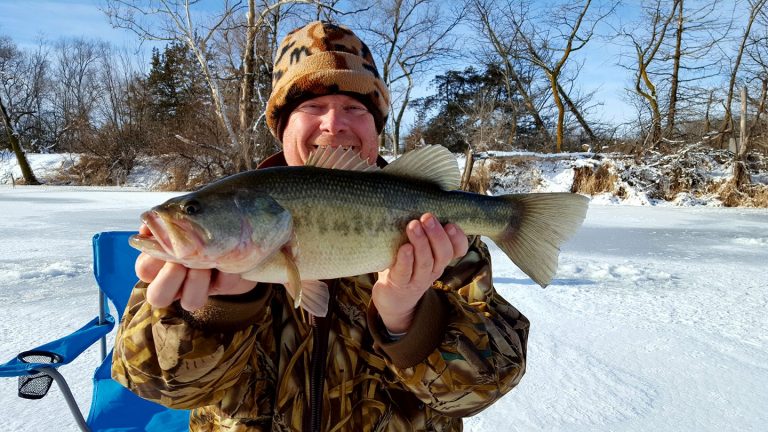
Contrary to what some folks think, most fish do feed in the winter. Depending on where an angler is, several active types of fish school up so the opportunities are there. Ice fishing techniques vary though with the fish species being sought, but it all comes to naught if the ice angler fails to select the proper rod-and-reel combo, line, lure or bait, and fish the right area, water and depth, plus detect the bite and hook the fish. Successful ice anglers have come to accept and appreciate these challenges. When everything comes together, there is no better experience than reeling in a 10-inch bluegill or 21-inch largemouth bass on a 2-foot rod with 4-pound test line. It has often been said by avid ice anglers that the rewards of a day on the ice make temperatures feel like summertime!
You can practice selective harvesting. Daryl Bauer states, “A lot of us enjoy eating fresh fish caught through the ice in the wintertime. They are delicious. Their flesh tends to be firmer and have a milder taste than that of those fish caught in the summer. However, the emphasis on taking fish home is a lot less than it used to be. That is a good thing, because if the oceans can be over-fished, there isn’t a body of water in Nebraska that can’t be. Catch-and-release or selective harvest (catching and keeping a few legal fish for a meal within limits, while releasing others) is being practiced by many ice anglers, and it’s a practice that can help maintain and improve the fishing for all of us.”
So, now you know why normally reasonable people brave extremely cold weather to venture out onto a frozen snow and windswept body of water to freeze their tails off and stare down through a hole in the ice to catch a fish. Pass me another waxworm, will ya’…