
By Justin Haag
It’s always worth a stop.
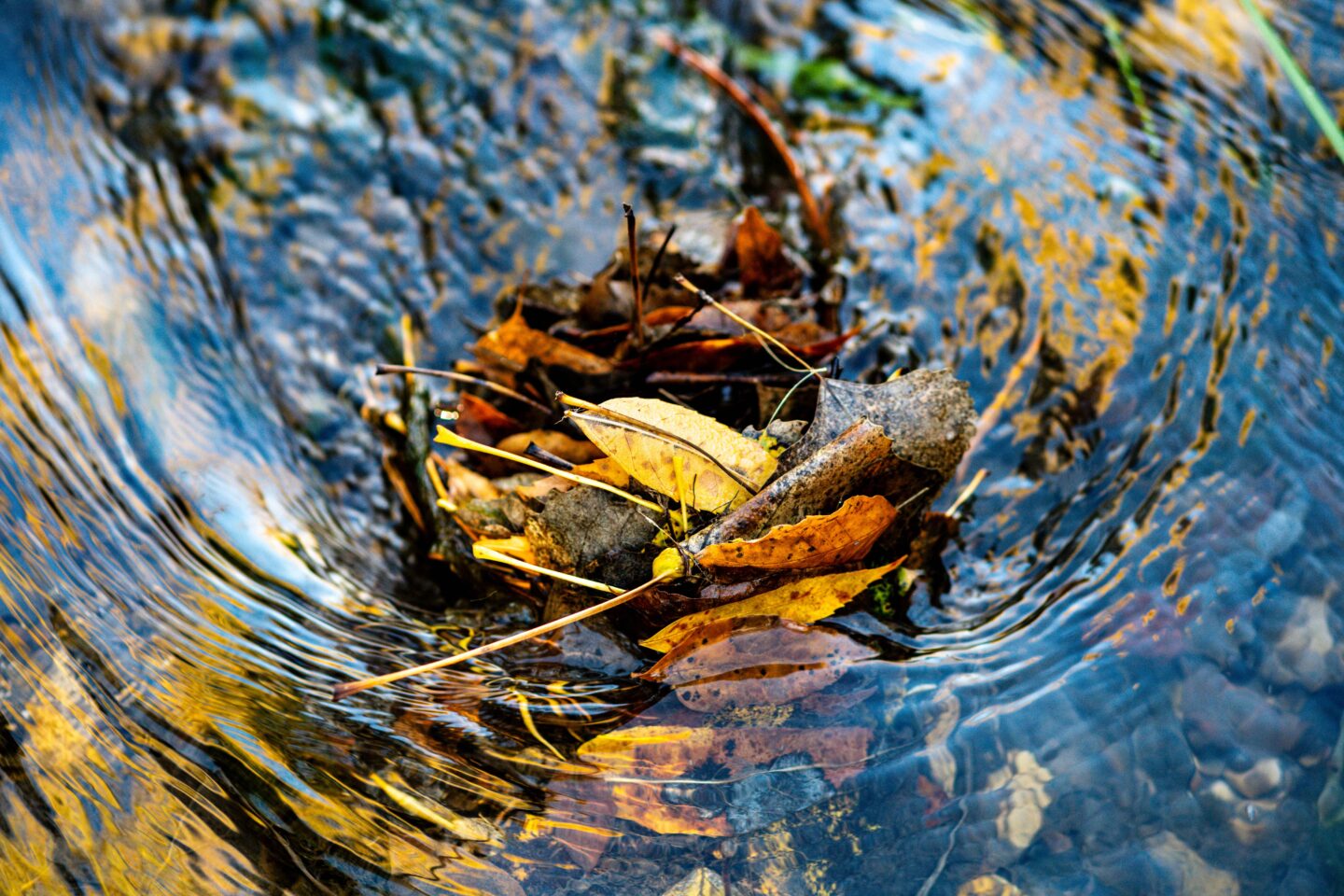
When fall arrives, I often find myself laying prone along a Pine Ridge stream photographing leaves that have gathered at an obstruction in the water’s flow. The cottonwoods, willows, maples and whatever other trees reside in the area project the diversity of a riparian area at leaf jams through reds, golds and browns, accented by the shimmering rush of the water, in a small package.
These leaf jams, or packs, not only make for nice fall imagery, but more importantly play a role in a stream’s health.
As microscopic fungi and bacteria break down the leaves, they become a source of nutrition for the stream’s creatures at the lower end of the chain. These macroinvertebrates, such as caddisflies and mayflies, later serve as food for fish, amphibians and birds. Similar to other obstructions in a stream, leaf packets can also function as a place for fish to hide and rest.
As fall turns to winter, these leaves slowly release nitrogen and carbon — essential building blocks for stream life.
Researchers often take a close look at leaf packs to assess a stream’s health, as the presence and absence of certain macroinvertebrates can determine how pristine, or degraded, the water is. Some creatures are more tolerant to pollution than others.
Fungi. Bacteria. Macroinvertebrates. Researchers. Photographers. For being such a model of serenity, these little jams have a way of packing in a lot of activity. Be sure to stop and take it all in. Or, just take a picture.