
By Gerry Steinauer, Botanist
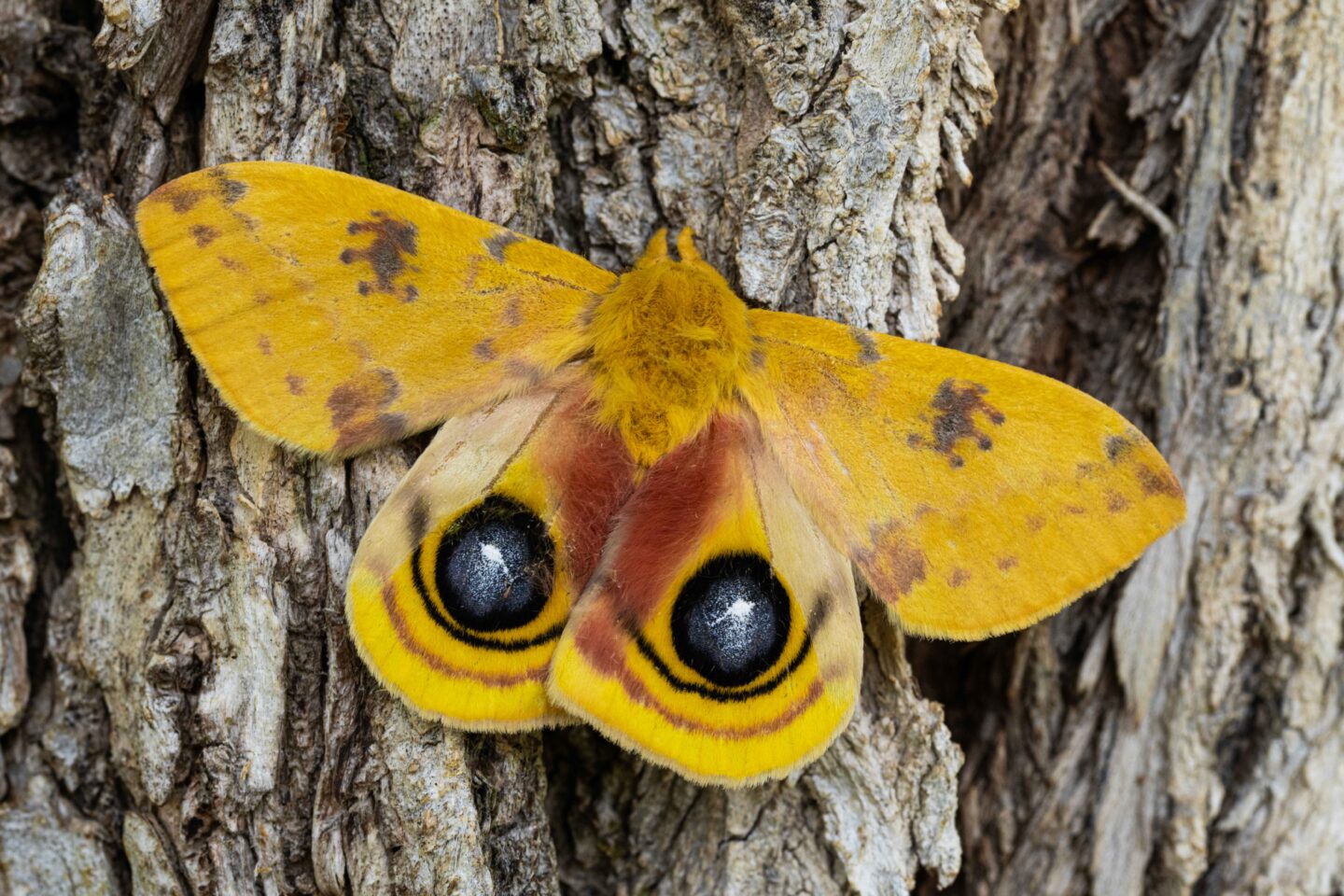
Last June, while hiking a spring-branch canyon at the Niobrara Valley Preserve in search of rare plants, I was twice met by pairs of staring eyes. Fortunately, they were not those of a stalking animal, but the eyespots on the wings of moths.
One set belonged to an io moth perched against the trunk of an elm tree, its inner hindwing eyespots starkly obvious. The other belonged to a polyphemus moth, its eyespots more subtle — almost camouflaged among the streamside vegetation where it rested — and noticeable only when I bent close to examine a plant. These markings are designed to startle and deceive predators such as birds and small mammals — or even an unsuspecting botanist.
Named for its eyespots — patterns formed by pigmented wing scales — the io (eye-oh) moth inhabits woodlands across our eastern and northern counties. When at rest, the eyespots are hidden by the yellowish forewings, helping to camouflage the moth. When disturbed, however, it flashes those glaring “eyes” by quickly raising the forewings.
Startled by the sudden display, an attacker may think it has taken on something larger—perhaps even one of its own predators — than it bargained for. This “startle display” works because predators often hesitate before attacking to gauge risk, allowing the moth a split second to take flight or drop to the ground to escape.
The polyphemus moth, a giant silk moth, shares a similar range and habitat in Nebraska with the io moth. Its name comes from the Greek myth of the Cyclops Polyphemus, reflecting the vivid eyespots on its inner hindwings and smaller ones on its forewings. Like the io moth, it flashes these markings if alarmed. These bright yellow “eyes” may mimic the eyes of an owl — one explanation for their effectiveness, as owls often prey on small mammals and other moth predators.
Because the polyphemus moth’s wings are thin and somewhat translucent, the eyespots show through to the outer surface, where they appear less bold. When the moth is at rest with its wings folded upright, only the outer eyespot on the hindwing is visible. If disturbed, however, it slides its wings apart, revealing its other “eye” and making the display more convincing. When perched in the open, it can fully extend its wings, exposing the larger, more startling inner eyespots.
That eyespots have evolved in other species — such as the luna moth, and the common buckeye and common wood-nymph butterflies — demonstrates the value of this strategy. The next time you see eyes in the woods, don’t be alarmed — it may only be a harmless moth or butterfly trying to deceive you.