
By Monica Macoubrie, Wildlife Education Specialist
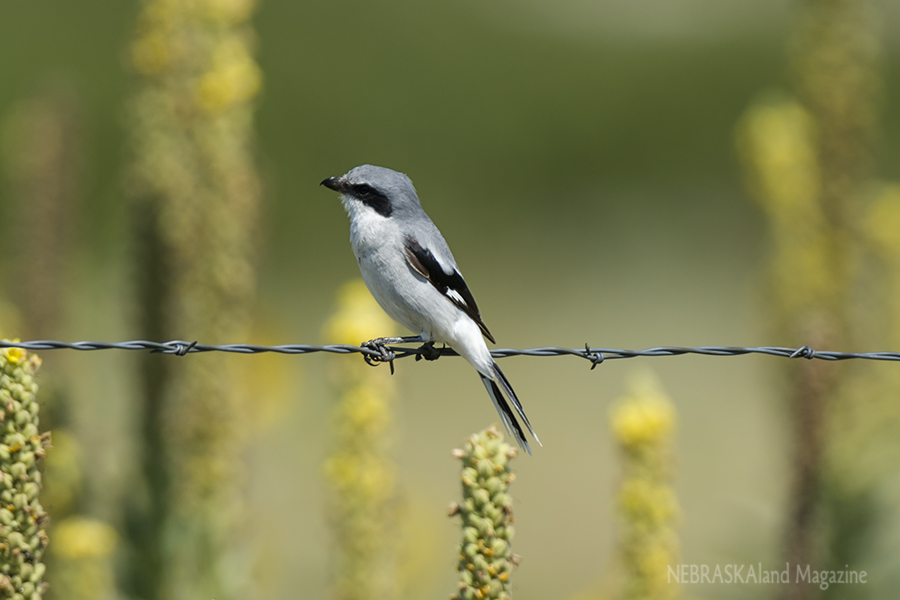
At first glance, the loggerhead shrike (Lanius ludovicianus) doesn’t seem particularly intimidating. This bird is about the size of a robin, is a nondescript gray color with black wings and sports a bold black mask that makes it look like a tiny raccoon bird. But don’t let the loggerhead shrike’s small size fool you. This songbird has earned one of the most ruthless nicknames in the bird world: the butcher bird.
The loggerhead shrike sings like a songbird, hunts like a hawk and has one of the most unusual feeding strategies in North America. It’s also one of my favorite birds to share with people.
The Most ‘Metal’ of Birds
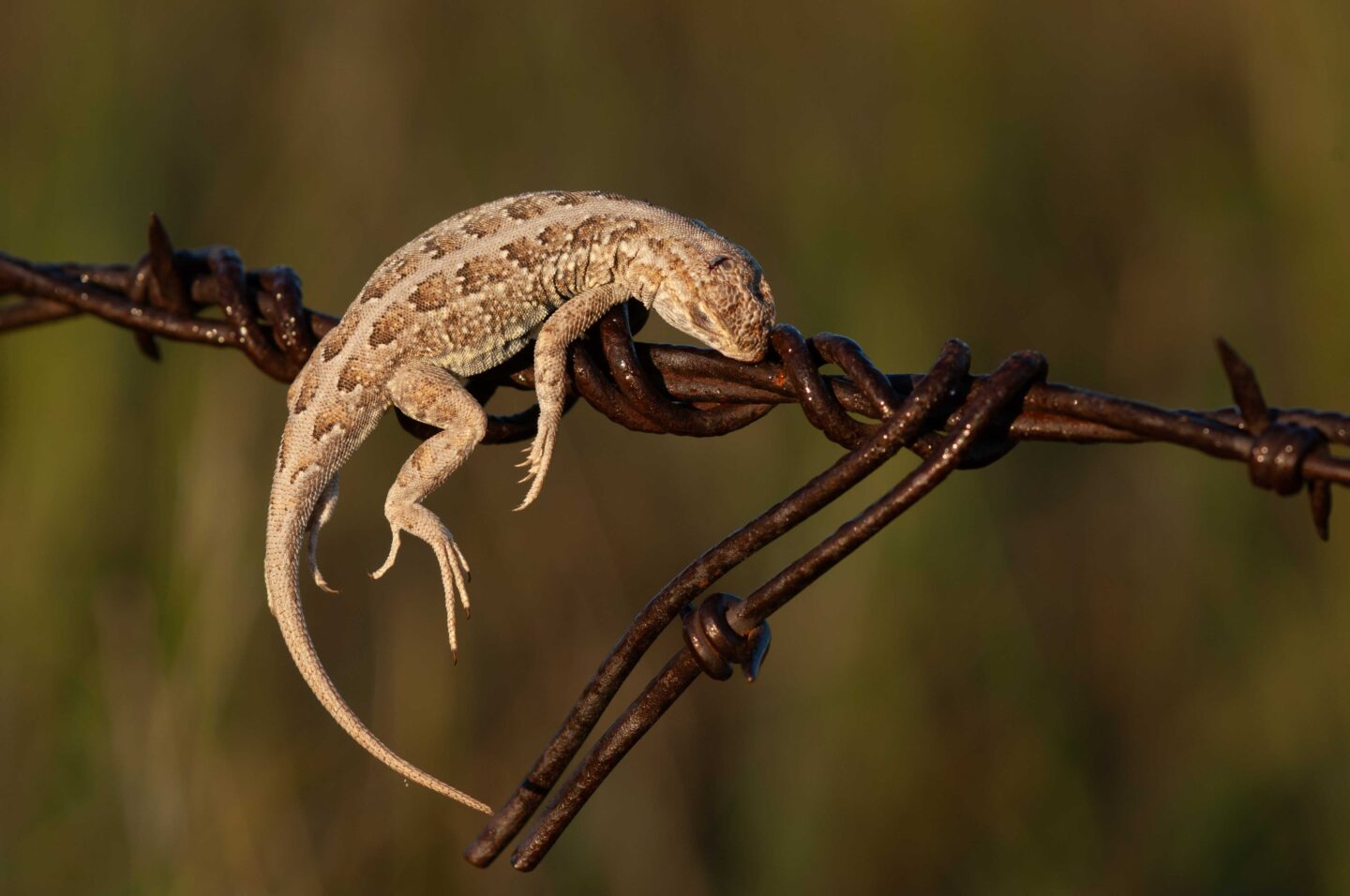
Most songbirds spend their days searching for seeds, berries or insects. Loggerhead shrikes take a different approach. These birds are skilled hunters that prey on grasshoppers, beetles, mice, voles, small snakes, frogs, lizards and even other birds. They perch quietly on fence posts, utility wires or isolated shrubs, scanning the landscape for movement. Once they spot prey, they swoop down with surprising speed and precision.
Unlike hawks and eagles, however, shrikes have several disadvantages. They don’t have powerful talons, can’t carry heavy prey and can’t use their feet to hold and tear apart a meal. Instead, they’re stuck with dinky passerine (perching bird) feet. Without the leg strength or weapons needed to wrestle struggling prey, shrikes have to kill quickly.
So how does a tiny songbird solve this problem? They use force.
A 2018 study published in Biology Letters used high-speed video to capture a loggerhead shrike catching a mouse by the neck with its pointed beak. The bird pinched the spinal cord to paralyze the mouse, then vigorously shook it with enough force to break its neck.
This bird is more metal than Metallica.

Why They’re Called ‘Butcher Birds’
After catching prey, these birds will often carry it to a thorny shrub, barbed wire fence or sharp branch and impale it. This creates a natural “meat hook” that holds the prey in place while the shrike tears it apart with its hooked beak. Sometimes the bird eats its meal immediately. Other times, it leaves the prey hanging for hours or even days, creating a pantry of stored food to eat later.
Shrikes even cache prey that many other predators avoid because they contain toxins, including toads, monarch butterflies and lubber grasshoppers. These animals can make predators sick, causing gagging, vomiting, or even death. Shrikes avoid the toxins by eating only the safest parts of the prey, such as the head of a lubber grasshopper, or by leaving the prey impaled for several days. During that time, many of the toxins break down, making the meal safer to eat.
Researchers have also found that male shrikes increase the size of their food caches before the breeding season. Males with the largest pantries tend to breed earlier and father more young than males with smaller caches.
Tiny Hunter, Big Appetite
During the summer, insects make up much of the shrike’s diet. Grasshoppers are especially important, and a single bird can eat dozens in a day. That makes loggerhead shrikes valuable allies for farmers and ranchers by naturally helping control insect populations. But when the opportunity presents itself, they’re anything but picky.
Shrikes have been observed catching:
- Mice
- Young rabbits
- Small snakes
- Tree frogs
- Lizards
- Dragonflies
- Butterflies
- Small songbirds, including sparrows, cardinals and goldfinches
For a bird weighing less than two ounces, that’s an impressive menu.

Where to Find Them
Loggerhead shrikes thrive where grasslands meet scattered shrubs and fence lines. Historically, Nebraska’s prairies provided excellent habitat. Today they’re often found near:
- Native prairie
- Grazed pastures
- Rural roadsides
- Shelterbelts
- Farm fields with scattered trees or shrubs
- Open rangeland
One of the easiest ways to spot one is by watching fence posts while driving country roads. Shrikes prefer elevated perches that give them an unobstructed view of the landscape below. If you notice a gray bird repeatedly diving into the grass before returning to the same fence post, you may have found one.
A Declining Grassland Bird
Unfortunately, loggerhead shrikes are becoming harder to find. Across much of North America, including Nebraska, their populations have declined by more than 80 percent since the 1960s. However, Nebraska’s population seems to be stable. Scientists believe pesticides, which reduce the insects shrikes depend on for food, have played an important role in that decline.
Other factors contributing to their decline include:
- Loss of native prairie
- Removal of hedgerows and shelterbelts
- Fewer thorny shrubs for nesting and food storage
- Changes in grazing practices
- Declining insect populations
Because they depend on healthy grassland ecosystems, shrikes are considered an indicator species. When shrikes disappear, it’s often a sign that the surrounding prairie is changing as well.

How You Can Help
If you own or manage rural property, small changes can benefit loggerhead shrikes and many other grassland birds.
Helpful practices include:
- Protect native prairie whenever possible.
- Leave scattered shrubs and shelterbelts on the landscape.
- Maintain healthy grasslands with a diversity of native plants.
- Reduce unnecessary pesticide use.
- Preserve thorny shrubs such as wild plum and hawthorn, which provide nesting sites and natural pantries.
Even leaving an old fence line in place can provide valuable hunting perches.
A Bird You’ll Never Forget
Nebraska is home to hundreds of bird species, but few are as memorable as the loggerhead shrike.
It’s a bird full of contradictions — a gentle songbird with the instincts of a predator, a tiny hunter capable of taking surprisingly large prey, and a prairie resident whose gruesome yet fascinating feeding habits have captivated naturalists for centuries.
The next time you’re driving a gravel road across Nebraska, take a closer look at the fence posts. That gray bird with the black mask might just be the prairie’s smallest butcher, quietly watching the grass for its next meal. Once you’ve seen a loggerhead shrike in action, you’ll never mistake it for an ordinary songbird again.
Photo suggestion: BG20050429_3977 CMYK.TIF
Photo caption: Loggerhead shrike during winter in the willows along Blue Creek, south of Crescent Lake National Wildlife Refuge in Garden County.