

By Monica Macoubrie, Wildlife Education Specialist
Kingfishers are loud, fast and just a little bit dramatic — appropriate behavior for a bird that dives headfirst into the water for a living.
Kingfishers belong to the family Alcedinidae, a group of small to medium-sized birds with large heads, long pointed bills and bright, bold plumage. There are over 90 species worldwide, each adapted to slightly different environments and diets. One of the most familiar species in the United States is the belted kingfisher (Megaceryle alcyon), commonly found near rivers, lakes and wetlands throughout Nebraska and the Midwest.
Kingfisher Characteristics
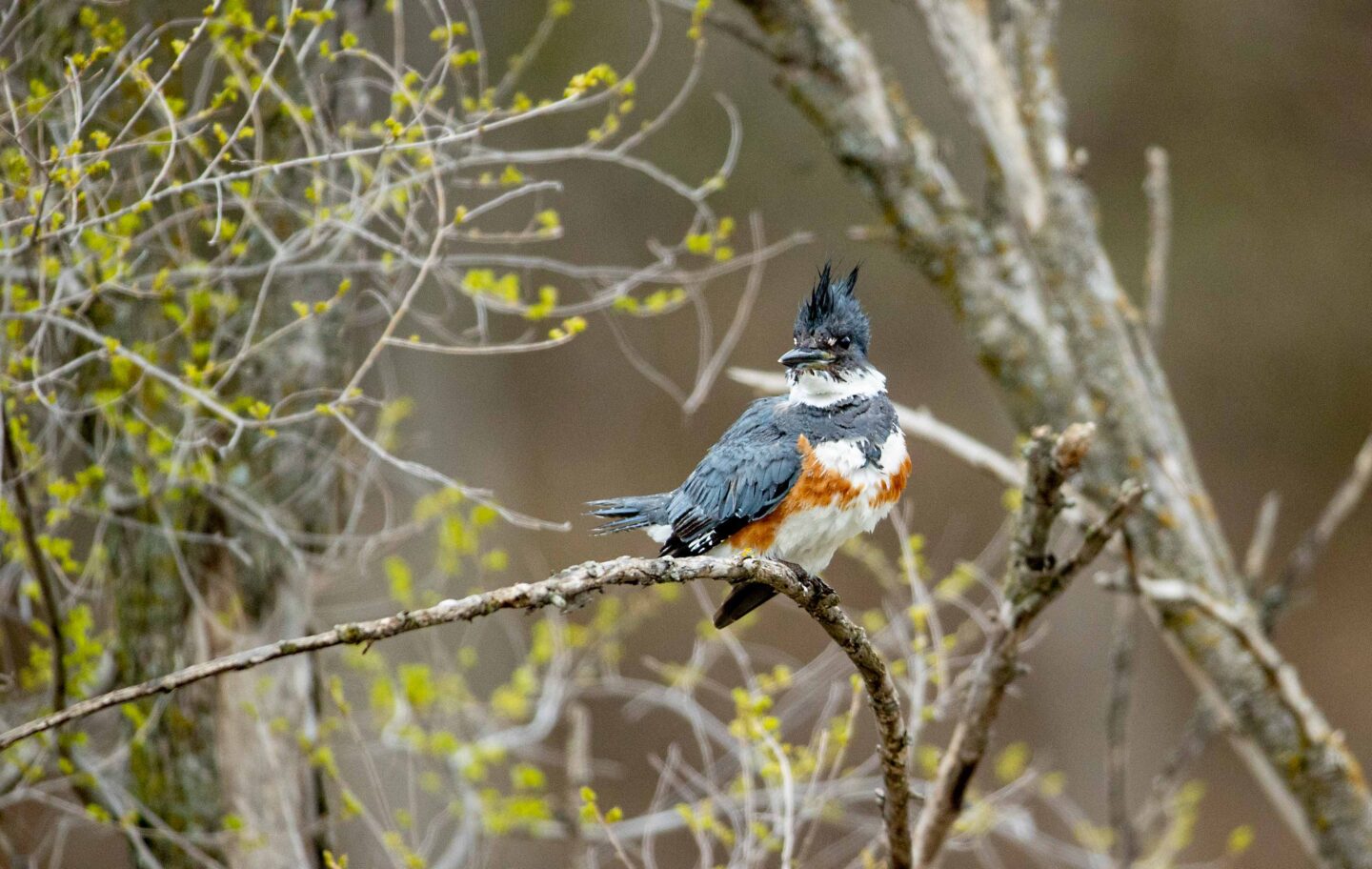
At first glance, they seem a bit pieced together — almost like their features don’t quite match. Their head is noticeably large, and the bill is long, thick and pointed. Meanwhile, the body is compact, almost like an afterthought, and the tail appears unusually short.
But there’s a reason for every detail. That oversized bill is perfect for catching and gripping slippery fish, while the sturdy head helps absorb the force of high-speed dives into the water. Their compact, muscular bodies are made for quick bursts of movement rather than long flights. Even their small feet fit their lifestyle — they aren’t built for walking. Instead, these birds perch, hunt and move on.
One of the more surprising details about belted kingfishers is the difference between males and females. In many bird species, males are the more colorful ones. In this species, it’s the opposite. Females have an extra rusty-colored band across their chest, in addition to the blue-gray band both sexes share.
You’ll Hear Them Before You See Them
Most birds ease into your awareness. Kingfishers don’t.
That rattling call carries! Especially over water. Once you’ve heard it, you start to recognize it immediately. It’s sharp, fast and a little chaotic, rarely settling into a rhythm. You’d hear a belted kingfisher long before you ever see it, and by the time you look up, it’s often already in motion — flying low and fast over the water, following the shoreline or cutting straight across a pond.
Their flight is direct and purposeful. No circling, no drifting. It’s point A to point B, wings beating steadily, body held straight. They don’t waste time in the air. And just as quickly as they show up, they’re gone again, usually still calling as they leave.
An Unexpected Nesting Strategy
For a bird that seems so bold and visible, their nesting strategy is, by contrast, obscure. Belted kingfishers dig burrows into vertical dirt banks along waterways, and these tunnels can be several feet long, ending in a nesting chamber where eggs are laid and chicks are raised.
Both males and females help with the digging, using their bills and feet to carve into the soil. It’s not a quick process, but it creates a space that’s protected from most predators and shielded from the elements.
Built To Hunt
Everything about a kingfisher comes back to how it hunts. They rely heavily on sight, watching for movement beneath the surface of the water. From a perch, they’ll tilt their heads slightly, adjusting their angle to get the best possible view through glare and ripples.
Then there’s the dive. It’s fast and fully committed without testing the waters. They launch forward and drop straight down, entering the water bill-first. The shape of their body actually helps streamline the dive, reducing splash and resistance.
They also have a specialized clear eyelid, called a nictitating membrane, that slides over the eye just before impact. It protects their vision and helps them see underwater during that split second when everything matters.
When they come back up, they either have a fish — or they don’t. And if they don’t, they go right back to watching.

Where to Find Them
The belted kingfisher is a regular presence across Nebraska. Anywhere there’s water — rivers such as the Platte, quiet backwater ponds and even smaller lakes — you’ve got potential kingfisher habitat. What they need most is a combination of open water for hunting and nearby perches to watch from.
They’re more abundant than people realize. The trick is tuning into their patterns — the call, the flight path, the places they return to again and again. Once you start noticing them, you start realizing they’ve been there all along.
Kingfishers don’t soften their presence to fit the landscape. They stand out in it.