
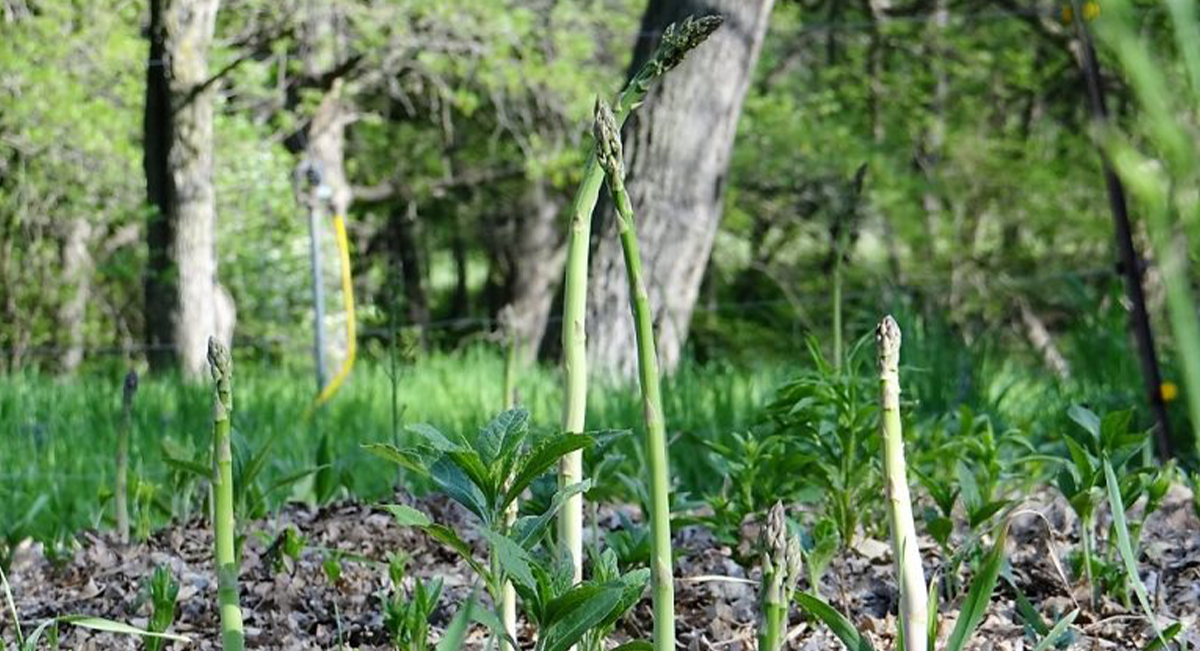
By Greg Wagner
They are showing up in the farmer’s market where my wife and I shop for seasonal fresh vegetables. That tells me that they are or will soon emerge in the Nebraska countryside where there has been adequate moisture and the right conditions. THEY are wild asparagus spears! Mmmm… So tasty!
However, where does one go to find wild asparagus in Nebraska? The rogue plant (botanical name Asparagus officinalis), which typically grows much taller and thinner than the supermarket type, can seem difficult to locate among other vegetation.
Wild asparagus, a hardy plant that comes back from the same root system every year, has many varieties. Asparagus growing freely in the countryside tastes no different from the cultivated kind, except that it has a fresher, more vibrant flavor. With that in mind, none of us though, will give up our spring wild asparagus harvesting spots. At least, I won’t — HA!
All I can say is that I have found wild asparagus in May from Holt County in northeast Nebraska to Lincoln County in southwest Nebraska. With prolonged drought, moisture is the big key! Nevertheless, where does a person specifically find wild or feral asparagus?
Where to look
Asparagus needs light & moisture.
Keep in mind that wild asparagus needs sunlight and moist soil but does not care much for the shade of large, mature woodlands! This herbaceous, long-lived perennial vegetable, introduced to North America and referred to as “the original ditch weed,” prefers sunny spots, or mostly sunny spots, in rich, fertile, saline or alkaline soil with plenty of moisture content around water — along ditches, waterways, woodland margins, irrigation canals, roadsides, fence rows, field borders, pastures, wet meadows and even around old homesteads or farmsteads. Good soil moisture is vital for root and fern growth.
Find old gardens.
I have found much wild asparagus along the north and west sides of old abandon garden sites where they were most exposed to the sun, received moisture and did not shade shorter vegetables that were planted. Once you have spotted one plant, look very closely because there is bound to be more. I have often come across multiple plants within a 10- to 20-foot radius and even some stragglers a little farther out. I also look intently for dead plants from the previous year. There is often more than one spear spouting from where the dead growth is.
Look for wild asparagus in the fall or even mid-summer.
Honestly, the real secret to finding wild asparagus is to hunt for it in the fall. You can’t miss the feathery, bright yellow plants. Once you know where they are, you will know exactly where to look for the spears in the springtime. You can easily see wild asparagus in the middle of summer as well. When the plant “goes to seed,” the asparagus sends up a bushy, green, ferny stalk about two to four feet tall. There are often a few in a cluster and they are easy to recognize.
Check wild asparagus spots repetitively.
Wild asparagus produces new shoots from the roots, sometimes for several decades. If you do not damage the roots and leave some spears to grow fully, you can harvest asparagus from the same patch, as I do, every few days or so for a couple of weeks throughout spring .
Harvesting Rules & Ethics
Before you go searching for wild asparagus, know that you have an obligation to respect any land. You must have permission from the landowner to enter their property or the property they are overseeing. You need to know boundary fences so as not to trespass on other peoples’ property.
In addition, do not damage freshly planted farm fields. It is always important to ask if the area has been sprayed with potentially harmful chemicals like herbicides, pesticides, biocides, etc. As with harvesting any wild edible food, exercise care around it and don’t take it all. Offer to share some of your bounty with the landowner. If you are wondering, properties owned and managed by the Nebraska Game and Parks Commission are not open to harvesting wild asparagus.
Why pick it?
Wild asparagus is more than just a seasonal delicacy – it is a reminder of how closely food, landscape, and tradition are intertwined. For those willing to get landowner permission and wander off the beaten path, it offers a connection to nature that supermarket produce simply cannot replicate.