

By David L. Bristow, Nebraska State Historical Society
This page contains rare photographs of the Nebraska portion of the Oregon, Mormon and California trails in the 1860s. Photography existed during the decades when hundreds of thousands of people were heading west. Why so few photos?
Consider photographer Charles Savage. An English-born Mormon missionary, Savage learned photography in New York before opening a studio in Florence, Nebraska, in 1859. During his 1866 journey to Utah, he made the Nebraska trail images shown here.
Making photos in the field was not easy. Savage brought along a heavy, specially-built photography wagon. This rolling, sheet-iron-sided darkroom was 9 feet long and 6 feet high and filled with drawers for his chemicals and glass-plate negatives.
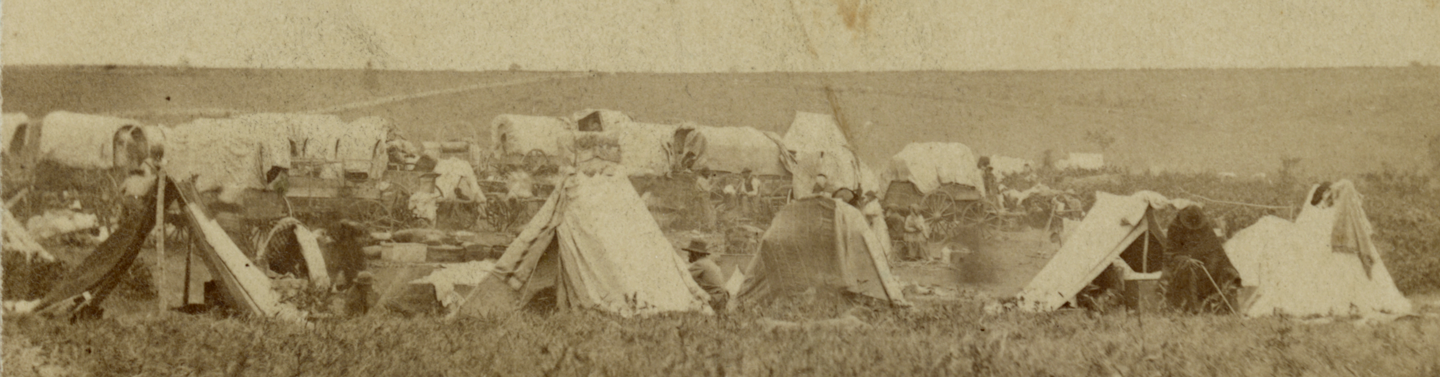
“Every time he wanted to make a negative,” writes historian John Carter, “he had to concoct his solutions, set up a camera, and pour his emulsion onto a piece of glass, expose and then develop it, all before the plate dried. This process could occupy upwards of half an hour.”
Savage made the trip with a group of Mormon emigrants. Not surprisingly, they did not want to wait while he stopped to make a photo, and by 1866, it was dangerous to lag too far behind the group. Native Americans had lost patience with the ongoing encroachment on their land. Even so, Savage managed to make a number of photos, some of which still exist.
The town of Florence — now part of Omaha — started out as the 1848 “Winter Quarters” when the first groups of Latter-Day Saints headed to Utah. By 1866 the town of Wyoming — a bit north of Nebraska City — had become the Mormons’ preferred “jumping-off” point. Savage made a photo of the emigrant camp before they departed around July 8.
From there, they followed a cutoff route to Fort Kearny, where Savage made another photo. He wasn’t very happy with it. Because of high winds and the long exposure time, the waving branches are hardly visible and the trees look like stumps.
Continuing west, Savage complained of constant wind that somehow did not disperse the swarms of green flies and mosquitoes. With daily temperatures rising over 100 degrees, it was often too hot for photo chemicals to work properly. That was the case when the group arrived at Scotts Bluff about midday, and Savage regretted that he could make no photo before they had to depart.
Fortunately, he was able to photograph Chimney Rock. The photo was long considered lost by historians until John Carter found it on eBay in 2008. Purchasing a rare artifact that way was still enough of a novelty that the story made minor headlines nationwide.
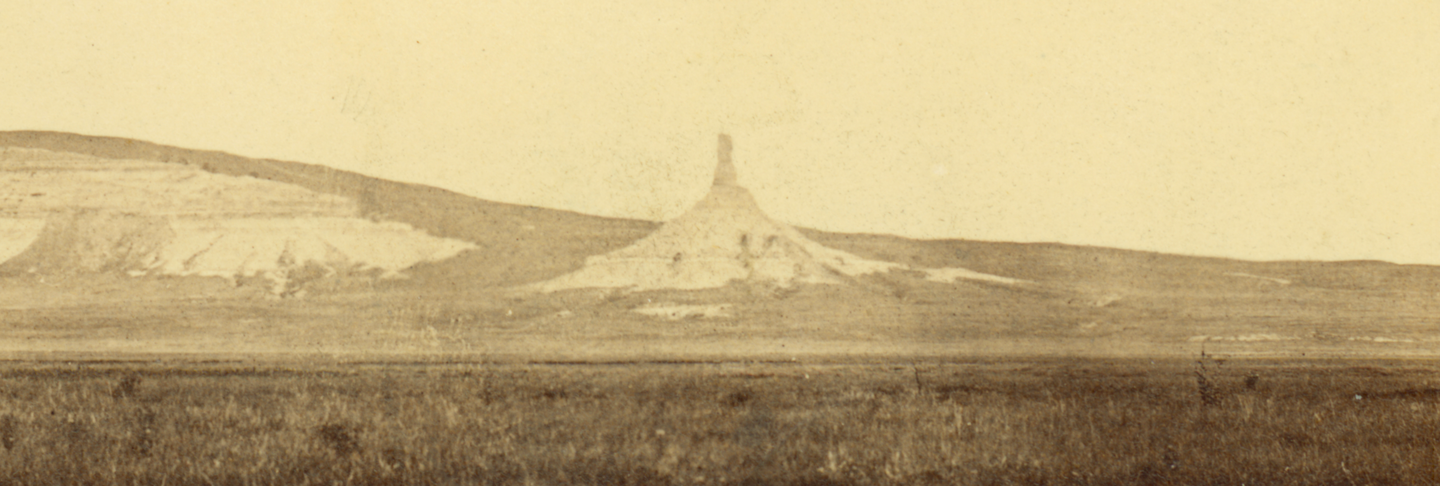
“So why did Savage bother?” Carter asked in a Nebraska History magazine article published later that year. “Photographers, especially then, did not photograph for posterity. Rather, they made photographs to sell.” And by then, Salt Lake City was a well-established capital filled with people who shared the experience of that difficult overland journey. “Savage knew his market well and, I suspect, found eager customers for his wares. His photographs were, in fact, the visual narrative of their experience, their journey to the Promised Land.”
As it turned out, 1866 was the last really big year of the Platte Valley route. Three years later, Savage made his most famous photograph, the iconic “golden spike” image documenting the completion of the transcontinental railroad.
John Carter wrote two articles about Charles Savage, available by searching “Charles Savage” at history.nebraska.gov.