
By Greg Wagner and Brian Peterson
Maybe you’re a hunter. Maybe you’re not.
But, there’s a unique form of hunting you will enjoy. It is a challenging and rewarding pastime that makes for an excellent family outdoor activity this time of year.
It is deer shed or cast (scientific term) antler hunting.
Beginning in late December and continuing through April, white-tailed and mule deer shed their antlers for regrowth purposes in Nebraska, with most deer dropping their antlers in March.
Based on white-tailed deer cast antler collections and camera trap research conducted by Brian Peterson and colleagues at the University of Nebraska at Kearney (UNK) approximately 35% of bucks cast by the end of February, 80% or more cast by the end of March, and all are cast by the end of April.
Wondering about cast mule deer and elk antlers? According to Luke Meduna, Nebraska’s Big Game Program Manager, the best months to hunt for the antlers of mule deer bucks and bull elk in western Nebraska are March and April. Meduna says, in most cases, “muley” bucks and bull elk in the west do not shed before March 1.
Some folks ask, “Does Nebraska law really allow a person to pick up, possess, buy, sell, or barter with antlers that have been shed or cast by deer and elk?” The short answer to that question is: Yes. Also, acquiring shed antlers on Nebraska Game and Parks Commission owned and managed properties is allowed.
So what’s it like on a shed antler hunt? Some compare a shed deer antler hunting session to an Easter egg hunt, but on a larger scale for better prizes and without all the candy, of course.
The objective of shed hunting is to slowly hike through the woods or fields in search of these hidden prizes — casted antlers! As you might expect, an antler lying on the ground or in brush isn’t necessarily easy to spot, especially if it’s small and it has been there a while or if there is a lot of grassy cover or deep snow. Their whitish-gray color can blend with cover on the ground. Sometimes, you’ll find a shed deer antler in the strangest of places. Also, each dropped antler is different and has one-of-a-kind characteristics, much like snowflakes, further lending to the intrigue of the hunt. Interestingly, some shed antlers show evidence of gnawing by squirrels, mice, raccoons and other small mammals, and in some cases by coyotes which both chew and carry them around, leaving distinct tooth marks and scoring behind. Be sure to check out the pictures and read the March 2026 Nebraskaland magazine article on the behaviors of wildlife chewing on shed antlers.
Finding deer antler sheds has become a very popular hobby for hunters and non-hunters alike. The rewards of a shed antler hunt are many. The antlers found in the wild can be used for everything from pure collecting purposes to dog chews to making crafts such as picture frames, knife handles, coat racks and chandeliers. Shed antlers may also be shared with others who may not have access to nature. The antlers can even be scored by the North American Shed Hunter’s Club.
However, shed hunting as it is called, is really so much more than those things. It goes deeper. This kind of hunting stimulates the emotional connection we humans have to the natural world. It is about wonder and awe. It makes you wonder if there is a thick, tall, wide set of antlers with many points glimmering in the sunlight amid the snow cover or leaf matter of a forest floor. The awe enters the picture the moment you locate, handle and examine one of these hard, weathered pieces of material containing a variety of minerals passed from soil to plants and condensed into blood-nourished bone.
You then have directly connected with nature’s handiwork. For passionate shed hunters, it is an emotional rush when you find an antler in the woods, along the edge of an agricultural field or fence line on a pasture or grassland prairie. And, locating a matching set of shed antlers is like finding a pair of gold nuggets!
Shed hunting forces you to know and connect with the land. You’re constantly, closely surveying the countryside. You see a variety of wildlife species in the process, many different birds. You’re looking intently for signs made by deer. You’re specifically looking for fresh deer tracks, droppings and beds which are obvious indicators that you may be near some antler gold.
Coming across rubbed trees or dirt scrapes made by bucks along deer trails is cause for additional excitement and will certainly prompt you to keep moving throughout an area in the hopes that an antler is laying on the ground not far away.
Shed deer antler hunting really is a simple outdoor pursuit, it doesn’t take much to do. You need to have permission from landowners to go on their properties, a partner (for safety), a Smartphone phone (for map apps), the proper clothing, a decent pair of binoculars (to glass at extended distances). A backpack may be used to carry shed antlers with the tips facing outward away from your body for safety purposes. Hunting for antlers is not a fitness race either, and should be done with a slower, more deliberate, leisurely pace so as not to walk past them.
There is also something about just being in the woods in late winter and early spring. You can walk into a wooded location, sit on a log and glass for the tines of antlers without hearing hardly any noises, except possibly for the wind whistling through the trees and your partner checking on your location. The solitude alone though is worth an antler hunt!
Searching for antlers develops skills for hunters and all outdoor enthusiasts. After a few trips, you gain an understanding of particular areas. You learn the use of habitat by wildlife, and the patterns of deer and other wild animals related to weather. You learn what white-tailed deer have for a winter diet that will also help on future, late season hunts. You learn that deer are creatures of habit — going to the same proximity to spend the winter every year. You also learn that shed antlers offer a snapshot of what particular bucks or what caliber of bucks survived the hunting seasons and are living in a given tract of land for next year’s seasons.
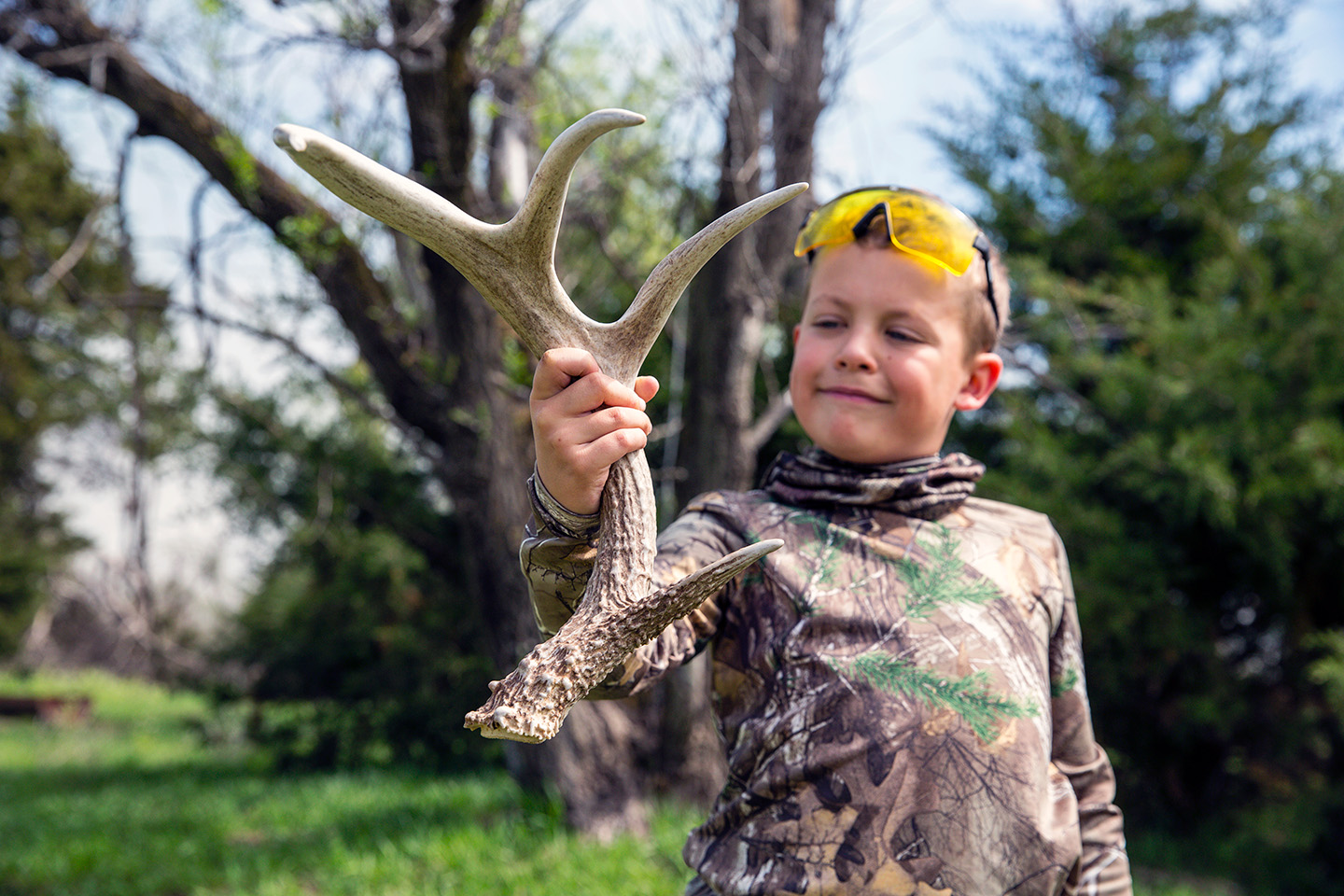
For youth, shed deer antler hunting represents awesomeness. It is a nice change of pace, different scenery and good energy release. Kids naturally have the components needed to become successful shed antler hunters. They are low to the ground and curious, love to play games, enjoy finding treasure, get excited to be in a wilderness setting and possess a lot of energy. The more young people become interested in outdoor activities like shed antler hunting the longer they will carry their enthusiasm and appreciation for nature and memories of their adventures with them.
New Research Highlights
- At the University of Nebraska at Kearney, based on a long-term dataset, we were only able to match up, or find the antler pair for 13% of shed antlers collected.
- 50% of all pairs were within 10 meters, and 75% of all pairs were within 100 meters.
- Regarding distance, shed antlers from older deer were found twice as far as shed antlers from yearling deer.
- Sheds from the same individual in subsequent years averaged about 500 meters apart, similar to the distance between harvested deer and their sheds.
- Key identifiers of an antler pair include the size, shape, and depth of the pedicle base (like a fingerprint), along with matching antler circumference and tine branching patterns from base to tip.
- Poor identifiers of an antler pair include number of points and length of tines.
Tips & Tricks
Don’t overlook staging areas. While feeding, travel, and bedding areas are productive places to search, staging areas are often missed. These spots, located just off primary food sources, are where deer linger before entering fields and rest between short feeding bouts during the night.
Avoid the sun. Warm, sunny days may be pleasant, but harsh light creates heavy shadows and eye fatigue, making antlers harder to distinguish from sticks and grass. Overcast or lightly misty days provide better visibility. If you must search on a sunny day, try to keep the sun at your back.
Avoid the snow. Snow can reduce search efficiency by covering antlers and increasing glare and eye strain. If possible, wait until the snow melts. When snow remains, focus on exposed, sunlit areas where deer are more likely to spend time than in shaded, snow-covered spots.
Where are the warmest areas in late-winter? After heavy snow and cold spells, think about the areas around your home and neighborhood that melt first. In the woods, these are often the same types of places deer seek out for warmth and areas with reduced snowpack and early spring vegetation. Focus on south- and west-facing slopes, as well as areas with vegetation that blocks the wind and absorbs the sun’s heat.
Don’t start searching too early. Bumping deer off a property prior to shedding can decrease your opportunity to find a target buck’s antler sheds so note what is happening with deer or elk and their antlers on your remote game cameras.
Going spring wild turkey hunting? Look for antlers. Shed antler hunting while wild turkey hunting in the spring is an excellent, productive combination. Late March to April is prime time for finding recently cast antlers. Be sure to scan the area you plan to set up for a turkey hunt.
Find the zone. If your goal is to find a lot of sheds, focus on identifying the season’s “shedding zone.” These areas can shift year to year depending on weather and the availability of winter food sources. Bucks often group up in late winter, so if you find one shed, there’s a good chance more are nearby. When you spot one, slow down and work a spiral search, covering an area roughly the size of a football field before continuing on your original route.
Brian Peterson is a biologist at the University of Nebraska at Kearney and coordinates the M.S Biology Online Program. His research focus is white-tailed deer antler metrics. He is also an avid hunter and outdoorsman and a frequent contributor to Nebraskaland magazine.