
By Julie Thomas
Dennis Ferraro is always ready to engage anyone and everyone about frogs, turtles and snakes — especially rattlesnakes, his favorite. A much-revered professor of wildlife biology at the University of Nebraska-Lincoln, his enthusiasm and passion for the conservation of North American amphibians and reptiles has inspired generations of students, whom he goes to great lengths to engage. Ferraro is known for pulling snakes from his pockets during lectures and inviting students to join him on late-night excursions to look for injured herpetofauna that might need veterinary help. The professor’s infectious love for amphibians and reptiles started when he was a child.
By age 9, Ferraro knew he wanted to become a herpetologist. His family home in Connecticut backed up to a wooded wetland, and Ferraro wandered around that wetland most days. Although this practice is highly discouraged and often illegal today, he began bringing home specimens and keeping them in a dresser drawer for observation. So, when Ferraro’s mother began finding snakes and frogs throughout the house, she prompted his father to buy aquariums and set up a room in the basement — Ferraro’s first real laboratory.
By age 13, the budding scientist was keeping an observation journal and making notes about frog calls and snake hiding places. Certainly, young Ferraro was a determined, curious learner, but it was his parents’ support of outdoor exploration, his science teachers’ mentoring, and the Boy Scouts of America that guided him to the perfect career.
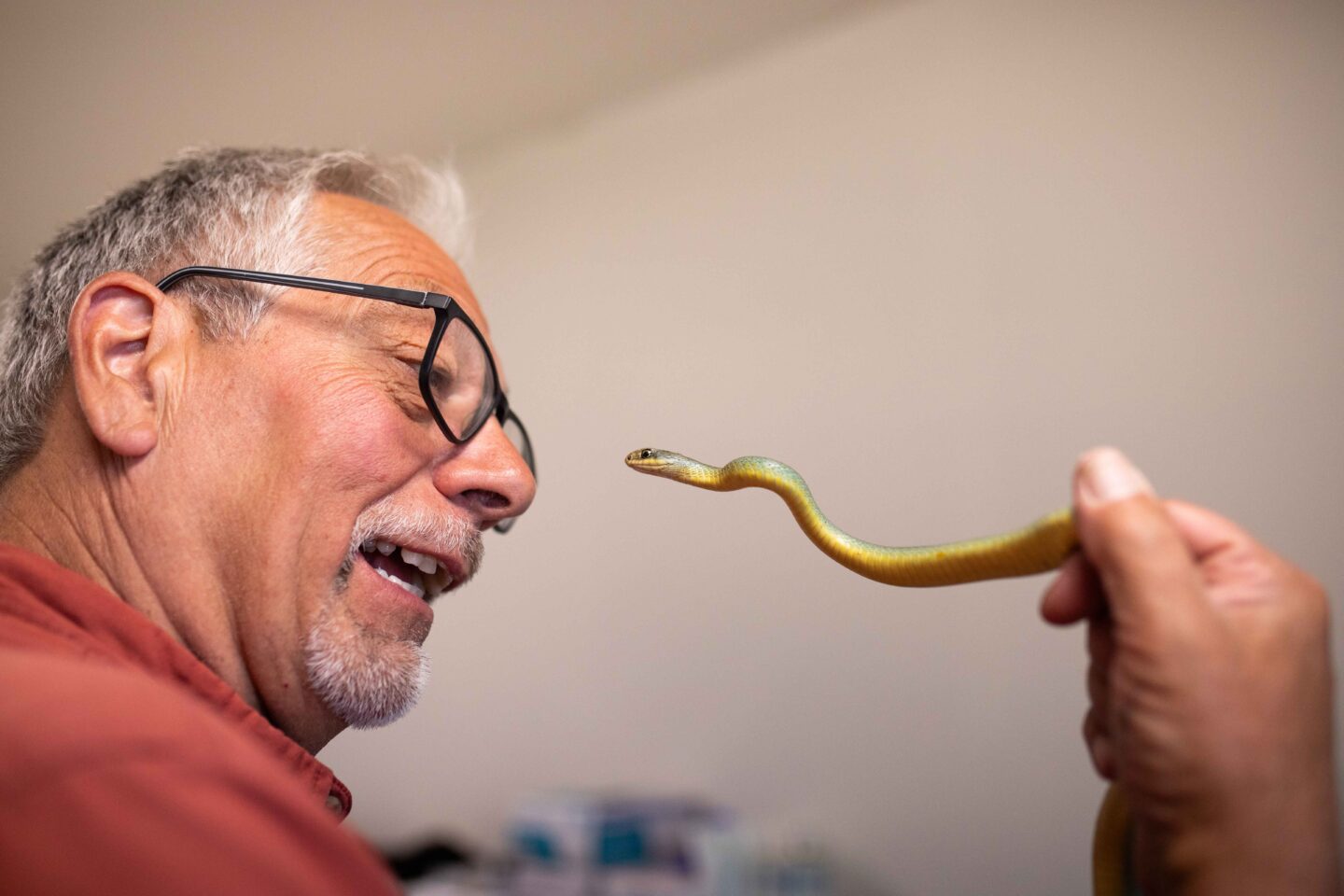
Today, Ferraro calls himself a conservation biologist, one who focuses on balanced-functioning ecosystems and their interdependent relationships. Ferraro’s concern for snakes has defined his efforts as a teacher. Lectures and field courses for students weren’t enough — he also needed to broaden public awareness: Reptiles, especially snakes like the eastern racer shown above, are largely misunderstood by the public, and often needlessly killed. To raise awareness, the herpetologist began collecting amphibians and reptiles for research and educational purposes.
Ferraro and his specimens, along with student mentees, have supported education programs across Nebraska, including presentations at Nebraska Game and Parks Commission outdoor expos. He also has appeared on Nebraska Public Media’s Backyard Farmer program where he helps viewers resolve conflicts with wildlife and damage control on their property.
As a scientist, Ferraro continues to travel Nebraska to update his 35-year database on herpetofauna populations — the rattlesnake birthing season being the most anticipated part of the year. He travels to protected areas, such as Nature Conservancy properties, where rattlesnakes fulfill an important part in that grassland ecosystem alongside prairie dogs and bison. While there, he counts, tags, weighs, measures and monitors baby rattlers. Ferraro finds the work immensely fulfilling.
In a way, we have the rattlesnakes to thank for keeping this talented scientist in Nebraska.
Julie Thomas is a University of Nebraska-Lincoln professor emerita and a Nebraska Master Naturalist. To celebrate our history of conservation storytelling, Nebraskaland will feature experts who have made a difference for Nebraska’s wildlife and wild places. For without their work, Nebraskaland writers would have fewer stories to tell.