

Story and photos by Gerry Steinauer, Botanist
My earliest memory of black walnuts is the sharp crack of a hammer striking their shells.
My dad loved black walnut (Juglans nigra) nutmeats in his brownies, a taste he likely developed during his childhood in Pawnee County, where this native tree is common. As a kid, sitting on the driveway, I would crack the nuts’ tough shells with a hammer and dig out the kernels from their tangled chambers to fulfill my job in brownie making. Not all the kernels made it into the brownies; I ate plenty right out of the shell, savoring their sweet, earthy flavor.
In college, I lived with friends in Vermillion, South Dakota, where tall walnut trees shaded the backyard. On autumn weekends, while grilling on the porch, we gathered fallen walnuts in their green husks and hurled them at a metal garbage can 30 yards away, scoring points for landing a walnut in the can or hitting the outside. It was great fun.
Later in life, as a botanist, I came to know black walnuts in a more professional light. During plant surveys and prescribed burns at Indian Cave State Park, I was awed by the occasional giant growing in deep, moist, never-logged ravines along the Missouri River bluffs. Their massive, branchless trunks, the envy of loggers, filled my mind with thoughts of primeval forest.
Black walnuts are common in eastern Nebraska forests, providing food and habitat for wildlife. People especially prize their rich nuts and dark, beautiful wood.
The Walnut’s Delectable Nut
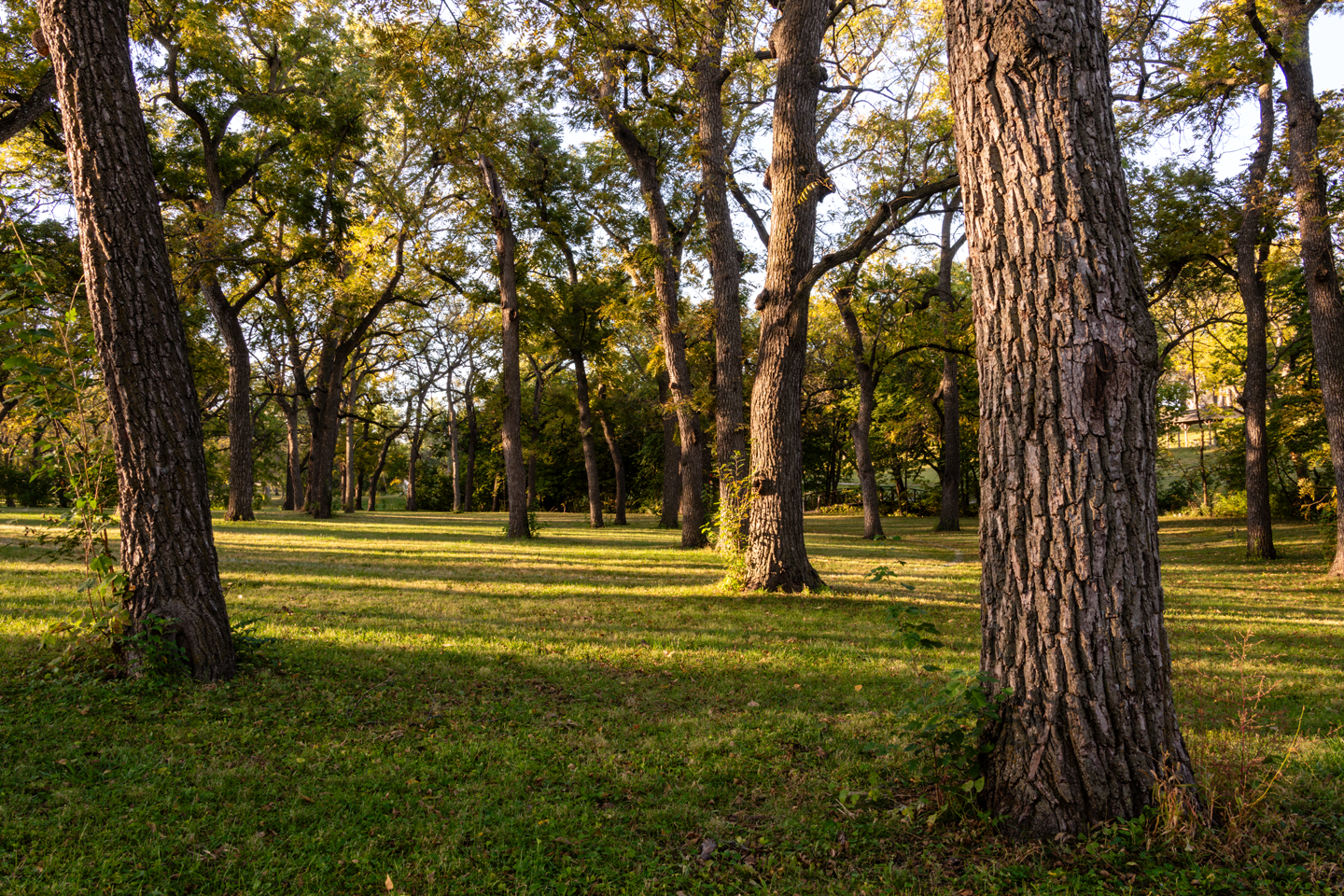
In eastern Nebraska, black walnuts grow in rich, moist forests along stream bottoms, low bluffs and upland ravines of the Missouri River and its lower tributaries. The species extends westward into central Nebraska along the Republican and Niobrara river drainages. On prime lowland sites, the trees can reach 100 feet in height, though 40 to 60 feet is more typical. Black walnuts have also been planted in groves for wood production and as yard trees, prized for the graceful beauty of their wide-spreading branches, dark bark and large, frond-like leaves.
The walnut’s wind-pollinated flowers appear in May alongside the leaves. Male blooms grow in drooping green catkins 3 to 5 inches long, while the female flowers are smaller and less showy, appearing singly or in clusters of two to five. By October, the nuts, encased in thick green husks, ripen and begin to fall, often to the dismay of anyone with a well-manicured lawn. On the ground, the husks dry and decay, turning chocolate brown or black. Inside is a ridged black nut, and within that, a creamy to golden-brown kernel.
Squirrels flock to the crop, feasting on some nuts and burying the rest for the cold winter ahead. Woodpeckers, mice, other rodents and even black bears can pry or chew through the hard shells for the rich reward inside.
People have also long valued walnuts. Archaeologists often find nutting stones at Native American village sites. These flat stones, with shallow, small, bowl-shaped depressions carved into the surface were once used to hold walnuts or other nuts while they were cracked with another stone. Some tribes boiled the walnut meats and skimmed the oil for cooking or ate them raw, roasted or ground into meal for breads and porridges. In Nebraska, the Pawnee, Omaha and Ponca ate them raw, mixed with honey or stirred into soups.

Among Euro-American settlers, nutting parties were both a social event and a way to fill the pantry. On pleasant autumn days, neighbors and friends gathered in walnut stands, the adults collecting nuts while visiting, and the children playing beneath the yellowing trees. Many nuts were eaten on the spot, while the rest were taken home, likely in bushel baskets on the back of a wagon, and stored to be savored in cakes, pies and candies over the coming winter.
I usually gather walnuts about a month after they fall, giving the husks time to dry and darken. This is a gamble: If the crop is small, squirrels may leave few behind. To husk them, I place the nuts on a brick or concrete and give the dried husks a few light taps with a hammer to loosen them before peeling them away. Then I crack the shell with firmer blows and pick out the nutmeats. It is slow work, but I find it relaxing and a bit nostalgic.
In “Wild Seasons: Gathering and Cooking Wild Plants of the Great Plains,” author Kay Young notes that the husk’s strong, pungent juice can seep through the shell and alter the nut’s flavor. She removes the husks as soon as the nuts fall, while still green. Her method is simple: Put on old rubber-soled shoes, roll each walnut underfoot on a flat rock or concrete and then remove the husks by hand. Wear gloves, as the husks’ juices will stain your hands a lasting, ghoulish green-black. After husking, she allows the nuts to dry and cure for about a month before cracking. For those who want to skip the work, shelled black walnuts are available online at a reasonable price.
The taste of black walnuts is not for everyone, as they have a stronger flavor than the mild, store-bought English walnuts. Young finds they pair well with baked squash and yams, fresh or cooked fruit and yogurt-based salad dressings. Her book includes recipes for black walnut caramels, fudge, toffee, bread pudding and cookies, all fitting autumn and holiday treats.

The Beauty of Walnut Wood
As early as 1610, colonists were shipping walnut logs from Virginia to England to be made into solid-wood furniture, which was often painted. Like the English, early Americans had little appreciation for walnut’s fine wood. They felled trees for more practical uses: fence posts, railroad ties and firewood. By the mid-1800s, when furniture styles improved and walnut was finally valued for its fine grain and rich color, lumber-grade trees had already become uncommon in settled regions of the country.
During World Wars I and II, demand for walnut wood surged because the wood is strong, shock- and warp-resistant and easy to work with. Walnut was used to produce millions of rifle stocks, propeller hubs and other precision parts for the war efforts. Government workers went door to door in rural areas of the Midwest, including Nebraska, to locate and harvest trees. They struggled to find enough, and during World War II buyers roamed as far west as the Little Blue River and Sandy Creek valleys in south-central Nebraska, far beyond walnut’s prime range in the state. By the end of that war, harvestable walnut had become even scarcer, prompting foresters to encourage landowners to plant walnut groves for future harvest and as an investment for their grandchildren.
Steve Karloff, a Nebraska Forest Service district forester based in Omaha, said Nebraska’s oldest planted walnut groves now have trees with trunks 16 to 18 inches wide and are not yet ready for harvest. Unfortunately, many groves were planted in poor locations, such as dry uplands or worn-out farm fields, resulting in exceptionally slow growth.

He explained that Nebraska’s finest black walnuts for harvest grow in native forests on stream terraces along the eastern edge of the state, where rainfall is highest and soils are moist but well-drained. Competing fiercely with other trees, forest-grown walnuts shoot straight and tall in a race to reach the canopy and sunlight. In the shade below, their lower branches receive little light, die and eventually fall away.
Trees prime for harvest have straight trunks for at least the first 18 feet, with few branches, knots or other defects, and are at least 24 inches in diameter a few feet above the ground. These rarities can bring landowners $2,000 to $3,000 apiece. The most valuable walnuts Karloff has seen in Nebraska grow in Hummel Park in north Omaha along the Missouri River. The largest of these giants have trunks 30 inches in diameter, and a logger once valued a single tree at $10,000.
Most walnuts in Nebraska, however, are not prime quality and bring far less value. For example, an elderly neighbor of mine had about 40 walnut trees in a woodlot outside Aurora. The best of them had straight, branchless trunks for about the first 12 feet and were 15 inches in diameter. Most had narrower, crooked or knotty trunks. He contracted with a logger to cut the trees and was paid only a few thousand dollars, a price I thought was well below their habitat and aesthetic value.
Not long ago, when working with woodland owners, Karloff completed 10 to 12 walnut timber appraisals a year, relying on a few southeastern Nebraska loggers to harvest the trees. Many of those loggers have since retired and not been replaced. Today, he does only three or four appraisals annually, with loggers now also coming from Iowa, Missouri and Kansas. He requires that loggers cut only a few of the larger, high-quality trees, leaving some for the future. Some low-quality, less valuable trees are also harvested.

Woodworkers have long favored walnuts from the drier Great Plains, where slower tree growth produces tighter rings and darker wood than in wetter regions to the east. There, faster growth yields wider rings and lighter-colored wood. Dark walnut is especially prized for veneer, a thin slice of wood applied to a base material such as plywood to give the appearance of solid walnut in furniture and cabinetry. Most prime American walnut logs, including those from Nebraska, are shipped to Europe and Asia, where they are highly valued and processed into veneer. Lower-quality logs from the state are milled locally into lumber for furniture, cabinets, gunstocks and other uses.
With no woodworking skills, my connection to black walnuts is personal. I admire the fine grain of my shotgun stock on autumn hunts, enjoy walks beneath the sprawling old trees at Walnut Grove Park in Millard and still crack and eat walnuts on my driveway.