
Daryl Bauer, Fisheries Outreach Program Manager
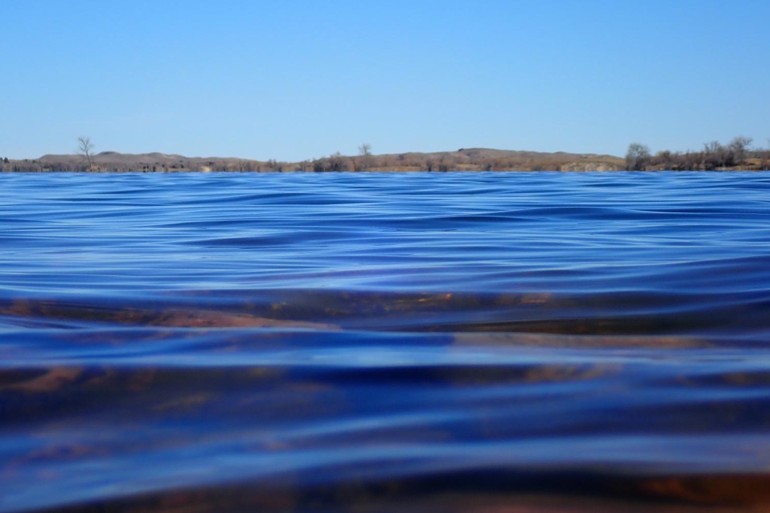
Living here on the Great Plains, you know that the wind blows. If you fish, I am betting that there have been times when you were cussing that wind.
Admittedly, depending on where I am fishing and what I am targeting, I occasionally wish for light winds. On the other hand, learned a long time ago that you cannot do anything about the weather. Might as well learn to make the best of it! Let ‘er blow!
In many fishing situations, our constant winds can be your best ally.
I will hop in a boat to fish every chance I get. However, most of the time I fish boatless. That does not mean I only fish small waters. On the contrary, often I put on a pair of waders and fish some of Nebraska’s largest reservoirs. Sure, an angler in a boat can cover more water, but as long as the wind is blowing, I usually can find someplace to catch fish, lots of fish, big fish.
That remains true right through fall. In fact, I pay closer attention to the wind speed and direction more than I do water temperatures.
Yes, where I fish may change from day to day depending solely on wind direction. Most of the time that wind will be blowing right in my face. Unless it is really gusting, the more the better.
If you fish flowing waters, rivers and streams, you know how fish relate to current. You have to learn how to fish those currents in order to catch fish. Thing is when the wind blows on lakes, reservoirs, pits and ponds, water starts moving. Moving water is current. If you can observe or even just visualize how those currents move on standing waters, you will begin to pick out high-percentage spots to fish. Specifically, here are some areas I am looking for through the fall:
Points
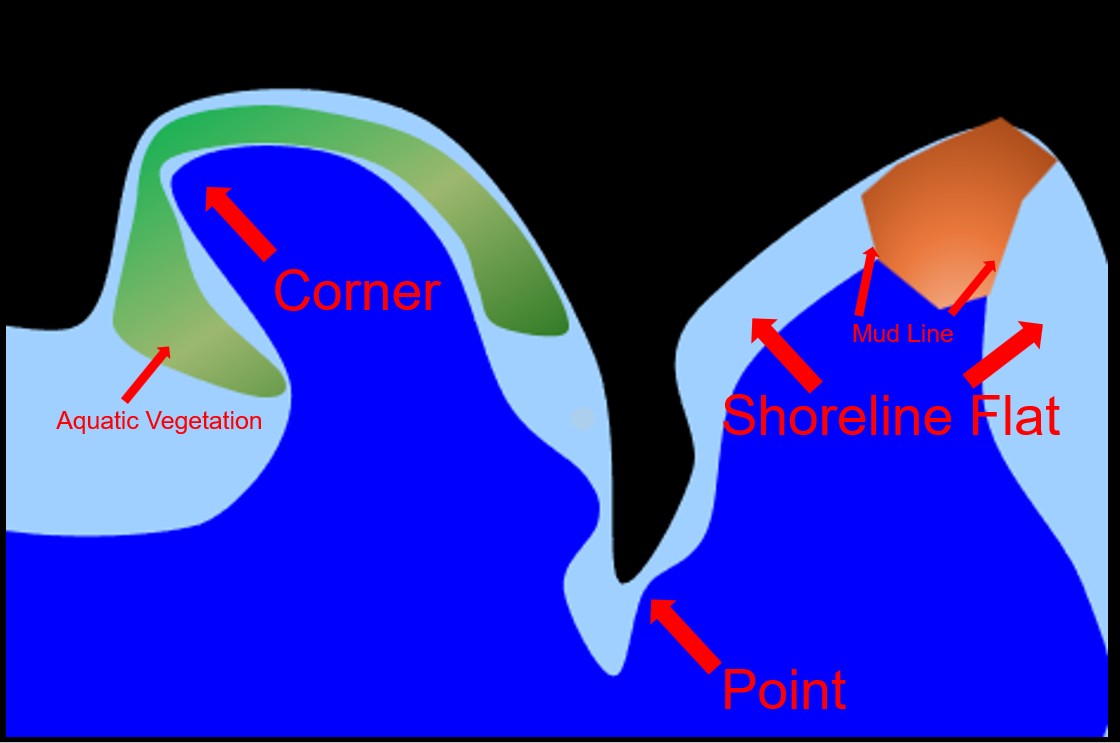
Everybody knows to fish points. Points are structures that just naturally tend to congregate fish. They are areas where predator fish will stalk and ambush prey. Wind blowing into or across a point makes it even better. Look at a point and how it intercepts and deflects current. That will give you clues on where actively-feeding fish will most likely be found.
Corners
The opposite of a point or outside turn in a breakline would be an inside turn or corner. These areas also tend to concentrate fish and are places where predators can corner prey fish. Inside turns get even better when the wind is blowing into them. As fall progresses, these can become some of the very best spots. That is especially true if the corners have fast breaks into deep water and if there is some still-green aquatic vegetation present.
Flats
Now I am going to go completely the opposite direction and say that shoreline flats can also be good in the fall. Yes, that pretty much includes everything, points, corners and also flats. However, on flats look close at how the wind blows into and across them. Small details on flats will be key points where fish tend to congregate.
Look for baitfish activity on a flat. That is the first clue. Also look for harder bottom substrates or other minor differences that might concentrate fish. Flats that have a breakline, even one of a few inches or one right at the shore, tend to be better. Any feature that might concentrate fish when the wind and water starts moving will be high percentage spots on a flat.
Specifically on flats, when the wind starts blowing, look for mud lines. Those mud lines are a visual clue to how shoreline currents are moving. You can bet that fish are relating to those currents and mud-lines.
Flats tend to be better early in fall or during a warming trend in late fall. Flats adjacent to deep water tend to be best.
Watch the weather. With experience you will recognize wind and weather conditions that will produce a good bite on specific spots. When the conditions are right, when the wind blows, clear your schedule and be there! The fish will be!