
Story and photos by Gerry Steinauer, Botanist
Before anyone makes a cast, a 25-pound channel catfish named Brutus must be fed. He’s been hanging around the dock for five or six years, and the Wednesday Night Fishing Therapy group considers him part of the ritual.
“We know it’s him because his whiskers are all rubbed off,” Mark Dietz said. Some evenings a couple smaller buddies drift in behind him, but Brutus is the regular. When Mark tosses a few handfuls of cat food onto the water, the big fish surfaces and gulps it down, unfazed by the commotion just feet away. Only after Brutus has eaten does the real therapy begin.
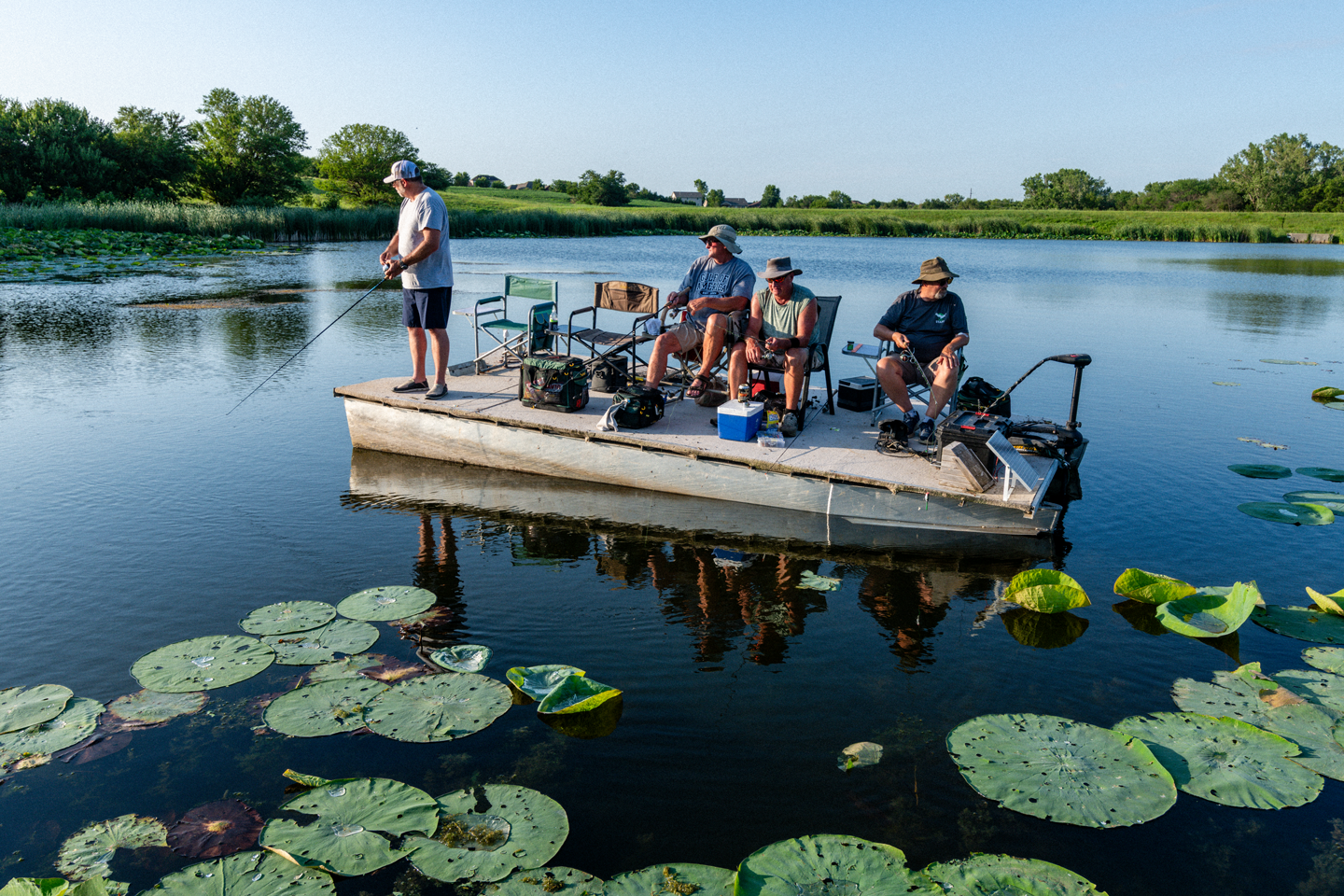
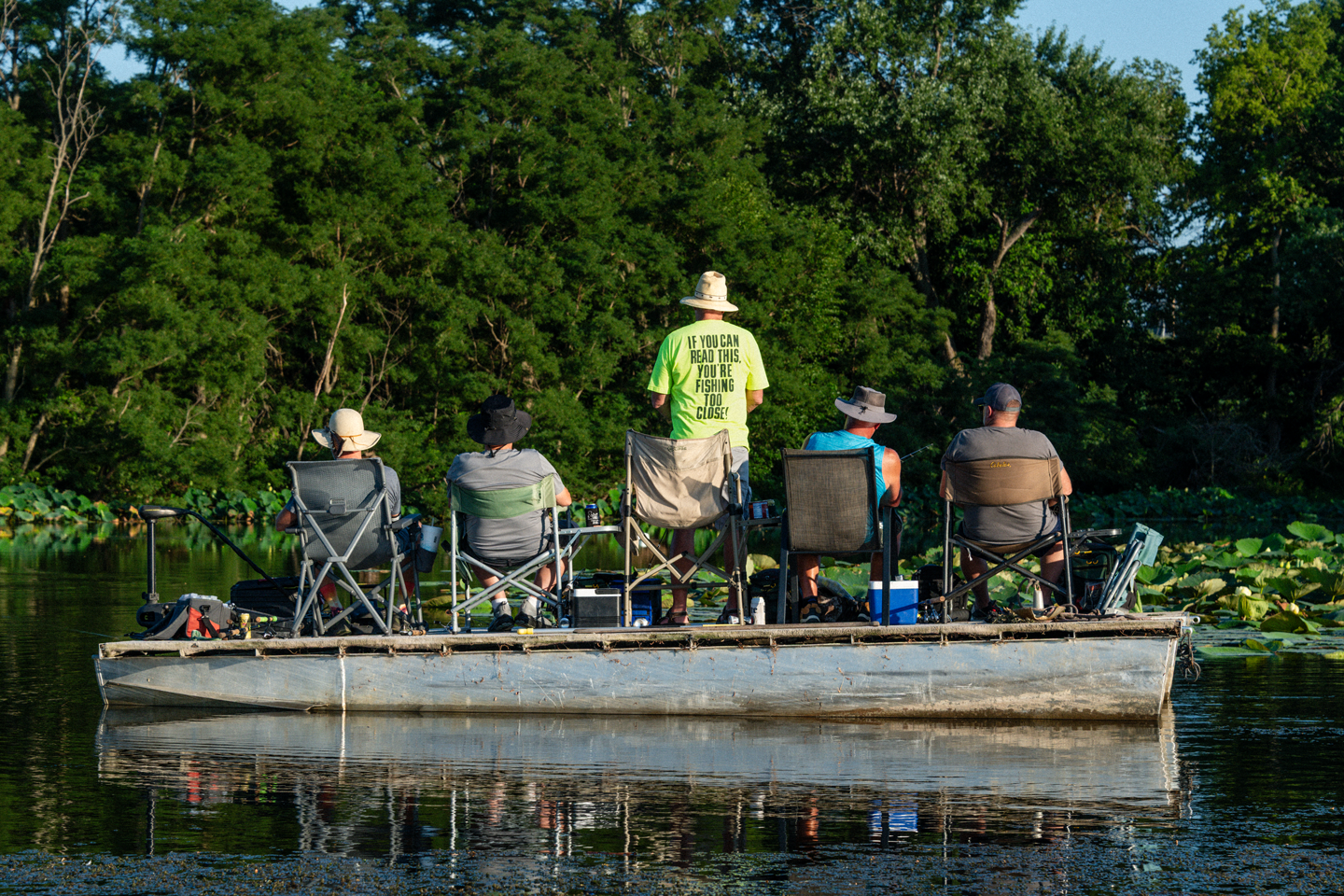
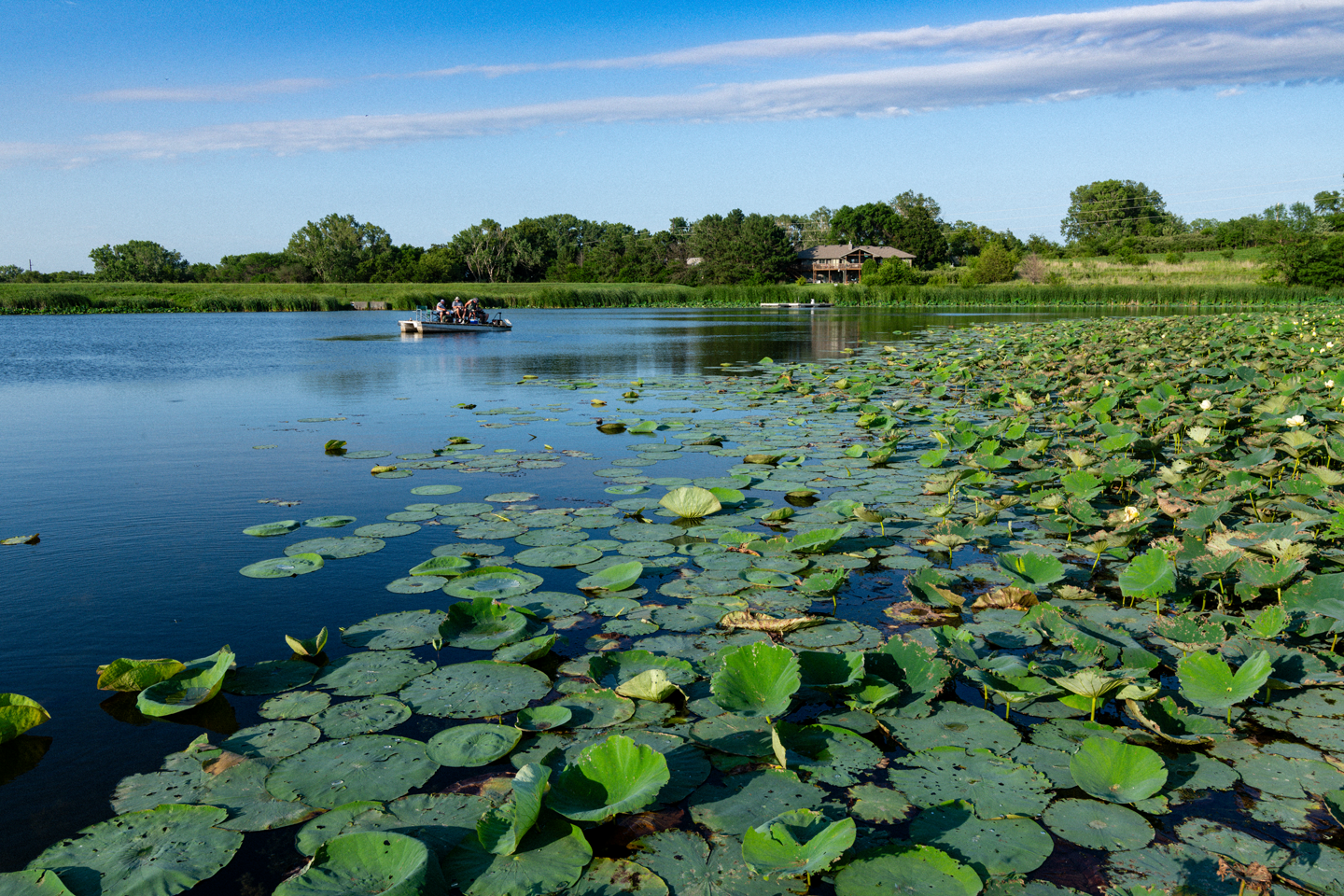
The group of Sarpy and Douglas County friends fish together nearly every week, May through mid-September, at Mark’s pond on the outskirts of Bellevue. They crowd onto a pontoon boat, christened The Barge, and circle the pond, casting until dark. The banter, joking and laughter are nearly nonstop. A poor cast or lost fish draws a barrage of good-natured jabs that only close friends can deliver. With this group, if you can’t take the heat — and dish it out — you’d best not come aboard.
The Therapy Group
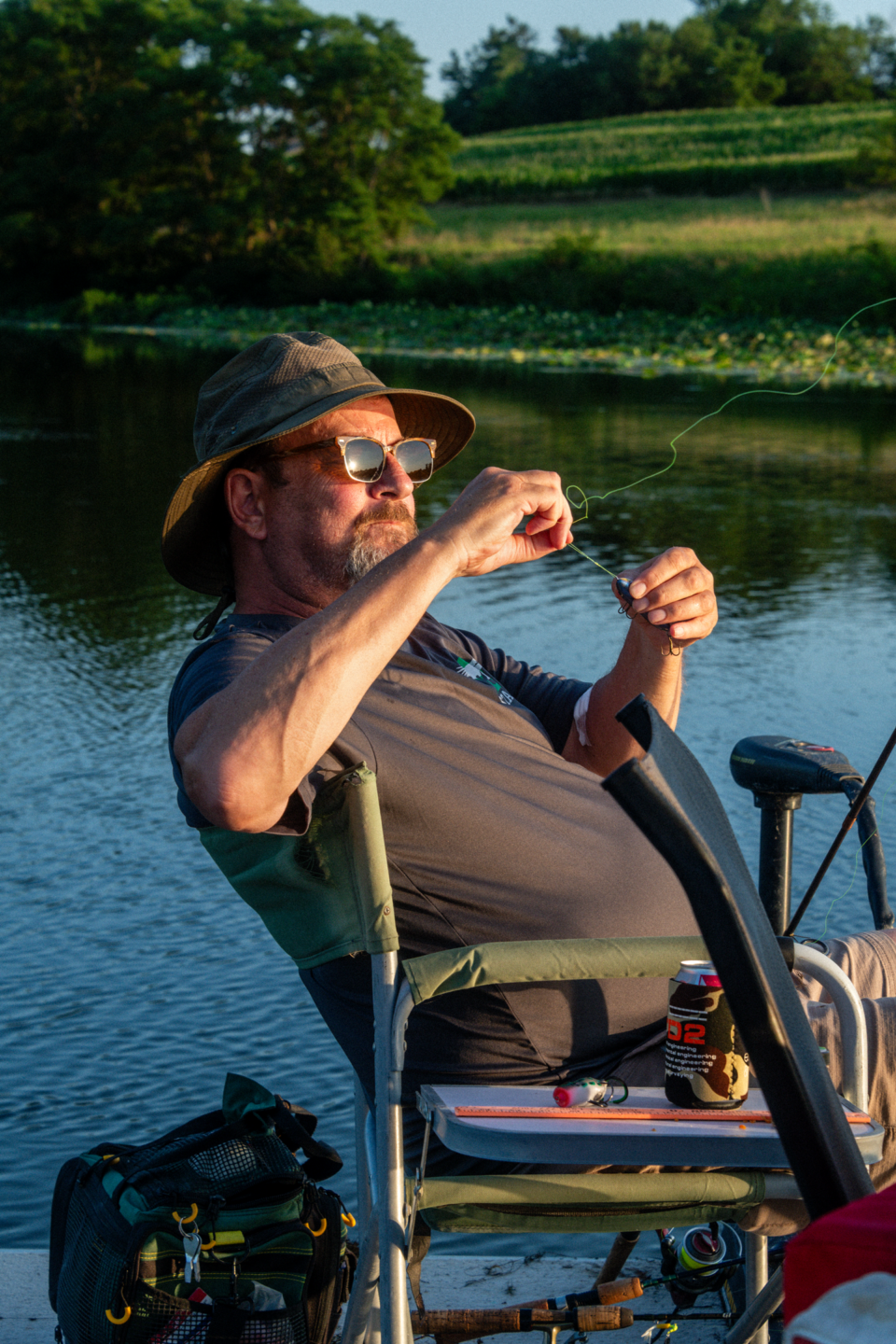
Mark, a Papillion native, is the heart of the group. In 1993, he started a Wednesday night fishing event at Lake Olivo, a Platte River sandpit where members had a cabin. In 2015, however, the group faced a crossroads: They were “booted from the cabin” when a campground was planned for the site. Undeterred, they began fishing a 6-acre flood-control pond adjoining 12 acres of grass and woods owned by Mark and his wife, Beth. They had purchased the land in 2002 from her grandparents, Glen and Mary Jane Miller, whose family had homesteaded there. The name Wednesday Night Fishing Therapy soon followed when, on a lark, Mark made it the title of a group text to see who would be fishing that week.
Today, longtime members include Dietz, Ron Koenig, Marty Giff, Todd Dubay and Steve Finley, along with a few newer faces. Each week, Mark texts seven or eight people to see who’s in, and four or five usually show up. A few guys come only once or twice a year. “They always have to mow the lawn, walk the dog or something,” he said.
The tight-knit group also takes part in other Dietz-organized events. These include the River Bottom Boys’ annual deer camp at his Platte River cabin, where “we sometimes shoot deer, but mostly we eat really well and watch a lot of football.” There’s also his 35-year-running annual triathlon, when more than 30 friends and family gather for a grueling day of golf, horseshoes and lawn darts. Lastly, they occasionally get together to sample Mark’s home-brewed beer and wine — some batches better than others.
An Evening of Fishing
Last year, Mark — whom I’ve been friends with for more than 35 years — invited me for an evening of therapy. In early July 2025, I met Mark, Ron, Marty and Gene Braun, a newer member, at the pond at 5 p.m., their standard starting time. While loading the boat with fishing gear, folding chairs and coolers, I asked Marty if he had gone to school with Mark. “No,” he said. “Dietz didn’t go to high school — he’s still trying to get his GED.” The tone was set.
Before setting off, Mark was unanimously — and without his consent — voted captain for the evening, responsible for running the trolling motor. As I later learned, the designation made him the target of sarcasm whenever his steering failed to meet the approval of his mischievous passengers. We were soon underway, slowly trolling across the pond’s quiet waters, quail whistling from nearby hills.
In the heat of summer, the group starts each evening fishing for bluegill and crappie in the cooler, deeper water in the pond’s center, using ultralight rods and casting 1/32-ounce jigs, mostly road runners. It took Mark years to talk the others into using 4-pound-test line and light jigs for panfish. “They couldn’t keep up with me,” he said. “I told them, ‘You gotta go light, baby.’”
They finally listened, and according to Mark, “now they catch fish.” In the pond’s clear water, heavier line is more visible, and fish avoid the jig. With an ultralight rod and 4-pound line, they can feel even the slightest bite, and casting light jigs is easier than with 6-pound line. On a good night, the group catches 30 to 40 panfish.
Before long, the guys landed three crappies. When Marty reeled one in, he gave an unexpected kudo to the captain for “steering him onto one,” then slipped the fish back into the water. “You know it’s going to be a good night if I catch a fish,” he added.
Soon, small bass and bluegill were hitting. During summer, the group practices catch-and-release, mainly because, as Mark put it, “nobody wants to clean fish late at night.” When ice fishing — when the fish are best eating — they keep moderate-sized bluegill and crappie and release the larger ones.
The pond holds mostly 10- to 11-inch crappie and 8- to 9-inch bluegill. After four decades of fishing it, Mark has noticed that panfish size tends to run in cycles — large for a few years, then smaller. He isn’t sure what causes the swings but believes water clarity plays a role. In wet years, runoff clouds the water, limiting sunlight and reducing aquatic vegetation. With fewer plants come fewer insects, and with less food the fish don’t grow as quickly.
As the evening wore on, the bantering and storytelling never let up. One frequent target was Steve — fortunately not in the boat that night — who has a reputation for being high-minded when it comes to fishing, spurning panfish and casting only for big bass. “He uses $75 lures that look like a muskrat swimming around the pond,” Ron joked.
Mark then told a now-fabled Steve story. “One night, Steve had a big bass strike that yanked his $800 rod-and-reel combo right out of his hands. He didn’t hesitate — he dove into the water after it, phone in his pocket and all. He got the rod, and the phone survived, but he lost his $100 Oakley sunglasses. We laughed our butts off.”
Switching to Bass
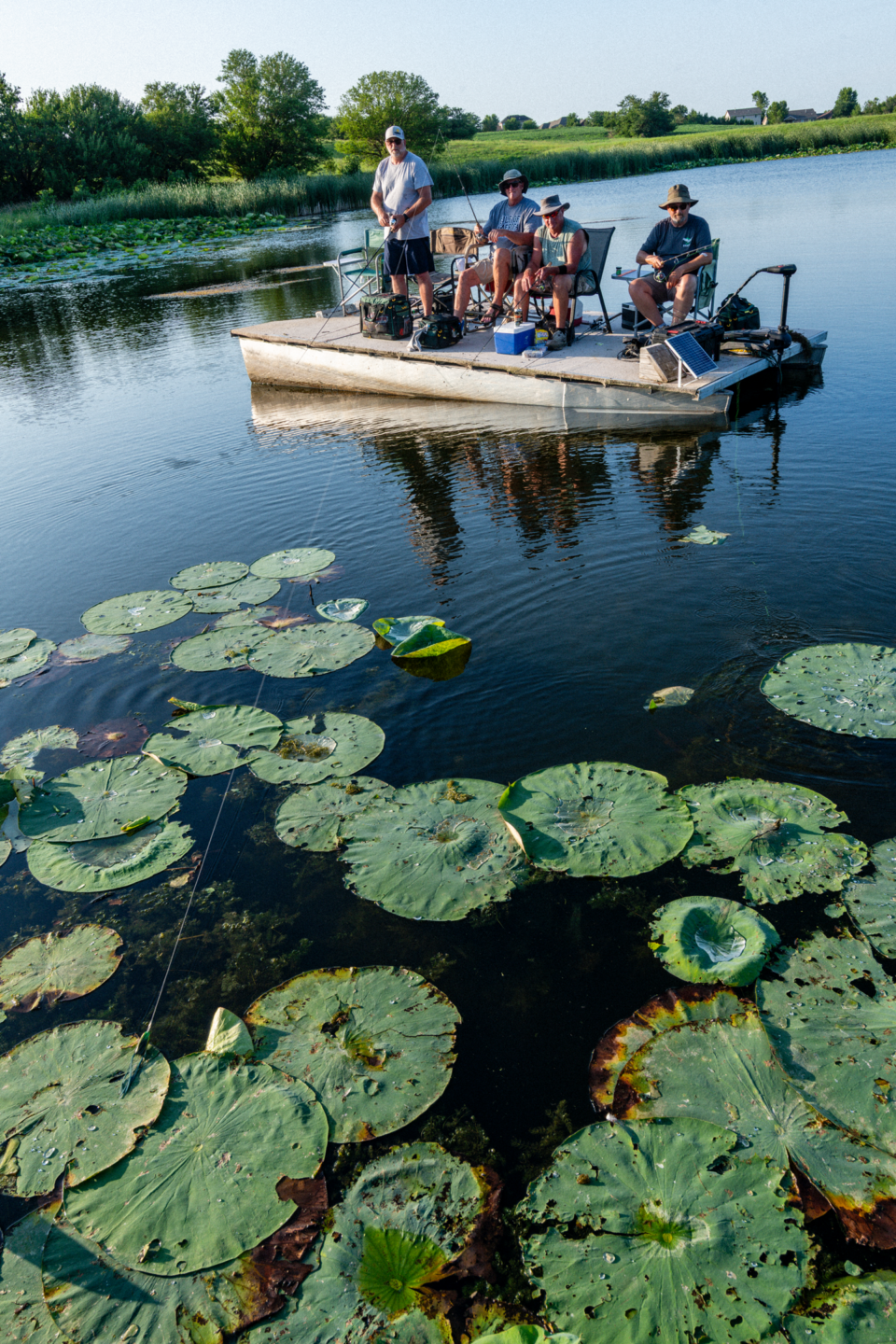
As the sun neared the horizon and bullfrogs began croaking from the shallows, the anglers switched to larger rods and heavier line for bass. From about 10 yards out, they cast rubber frogs and worms and crankbaits near — and on top of — the dense mat of American lotus pads ringing the shoreline.
A big bass swirled deep among the pads, prompting Mark to pitch his frog to the spot. The fish struck in a flash, but missed. The performance repeated on the next two casts, then the fish gave up the game. Seeing the action, Ron was prompted to switch lures and asked Mark if his frog was weighted. “Yeah, it’s got a little lead up front,” he replied. “Just like you,” Marty chimed in.
Gene, the least raucous onboard, gave me a smile and said, “Just like a bunch of kids. I’m nice to Mark because I’m new and want to be asked back.”
The bass hit consistently, though most were small; the largest weighed about two pounds. Mark said bass fishing in the pond isn’t what it used to be. They once caught many 3- to 4-pounders, but not anymore.
He believes the decline may be part of a natural cycle, especially since they release all bass. But he also blames the American lotus along the shoreline. In spring, big bass hold in shallow bedding areas, but the lure-snagging lotus makes casting nearshore difficult. “Lotus are good for fish, but not fishing,” he said.
When the sun slipped below the horizon, the group decided to call it a night. Mark turned the boat toward the dock and hit the throttle, allowing Ron one final jab at the captain. “I just got my last cast into the lily pads and now we’re going 60 miles an hour,” he said.
“Being captain stinks,” Mark replied. “I’ve been harassed all night.”
With the boat secured and gear loaded into trucks, the fishermen — keeping with tradition — sat in lawn chairs or leaned against tailgates and enjoyed a cold drink as they relived the evening. They agreed the fishing had been good, then headed home one by one until only Mark and I remained. As we said our goodbyes, I thanked him for the evening, and he invited me back.
“Sure thing,” I said. A bit more therapy couldn’t hurt.