

Story and photos by Eric Fowler
A 4-year study of walleye and sauger in Lewis and Clark Lake and the Missouri River above it confirmed what biologists had suspected: A high number of larval and young fish, and some adults, are flushed through Gavins Point Dam. It also revealed some interesting movement patterns of adult fish and the importance of deep-water habitat in the reservoir to wintering walleyes.
The study was a cooperative effort between South Dakota Game, Fish, and Parks, the Nebraska Game and Parks Commission and the University of Nebraska-Lincoln. Will Radigan, who conducted the field research for his doctoral study in UNL’s School of Natural Resources, implanted transmitters into the abdomens of 136 adult walleyes and 82 saugers captured in four segments of the 69 miles of river and reservoir between the Fort Randall and Gavins Point dams. He then tracked their movements from 2021 to 2024 by placing 16 receivers every 5 miles throughout the system.
Radigan found the movement of the tagged fish varied according to sex, species and where they were tagged. Of particular interest were some walleyes tagged below Fort Randall Dam that had migrated in the fall to deep water near Gavins Point Dam, where they overwintered before swimming back upstream in the spring. One tagged fish made that round trip twice.
“What we saw with the science mirrored what the fishing guides saw just going out there and fishing every day,” Radigan said. “They catch fish there, and our telemetry told us the fish are going right there in the winter, too.”
Other findings included:
- Many walleyes gather to spawn below Fort Randall Dam and in an area near Santee.
- Up to one-third of the sauger tagged in the delta in the upper end of Lewis and Clark Lake never left the delta and seemed to spawn there as well, indicating that they have the food and habitat they need there.
- Approximately 22% to 30% of walleyes and sauger were site residents, moving less than 6 miles from where they were tagged during the study.
- Sauger used up to 43 miles of the study area.
- Female walleyes tagged below Fort Randall used more of the study area than males.
- Walleye tagged near Santee utilized more of the study area (approximately 39 miles) than walleye tagged elsewhere (18 miles).
- Two fish tagged in the same location exhibited opposite behaviors: One moved between the dams, and one stayed close to where it was tagged.

Additionally, 12% to 19% of the tagged walleye and 10% to 15% of tagged sauger were harvested each year, rates similar to what has been documented in studies on Lake Oahe.
“I had one fish that got caught by anglers 3 or 4 different times, which is kind of crazy because I didn’t tag that many fish,” he said.
Just six of the 218 tagged fish passed through Gavins Point Dam. “That surprised me,” Radigan said.
However, using trawl nets set at various depths weekly between May and September below Gavins Point Dam, Radigan also found that roughly 8 to 16 million larval fish of 18 species were flushed through the dam each year. Of those, 90% were freshwater drum, and 14,000 to 75,000 were walleye and sauger. Radigan said that was 10 times higher than the number of fish flushed through Fort Randall Dam, which has a lower exchange rate and releases water from greater depths.
That confirmed what biologists in both states already knew: Lewis and Clark Lake is a wide spot in the Missouri River, with the volume of water being replaced, on average, every seven days. With that water goes some fish. During historically high releases in 2011, turnover occurred every 1.5 days. That figure was nearly matched during the flood of 2019. With high flows, the number of fish flushed through the dam is much higher.
“We find that when we have high water years, where releases through Gavins are over 30,000 or 35,000 CFS, our gill net catch in Lewis and Clark Lake drops, and there’s a pretty significant relationship to that over the last 25 or 30 years,” said Jeff Schuckman, district fisheries biologist for Game and Parks. Conversely, when releases are low, biologists catch more fish in their sampling nets in the fall. That was the case in the mid- to late-2000s when releases from the dam averaged less than 20,000 CFS, and biologists sampled 3 to 6 times more walleye than they did from 2011 to 2021.
Releases were below normal during the study, and it appears that fewer adult fish move through the dam during those conditions. “It’s hitting them when they’re little larval fish and the young of the year,” Radigan said. “It’s the cumulative effect through all of the different life stages that is the big deal.”
The study reinforced a decision by both states to stop stocking walleyes in the system. From 2014 to 2023, more than 40.3 million walleye fry and 9.2 million fingerlings were stocked in the lake to help it recover from the 2011 flood. Sampling showed those fish contributed little to the population.
“We had one year where the stocked fish contributed heavily, and normally it’s during a high water year, but most years we have more than enough natural reproduction up there to supply our recruitment,” Schuckman said.
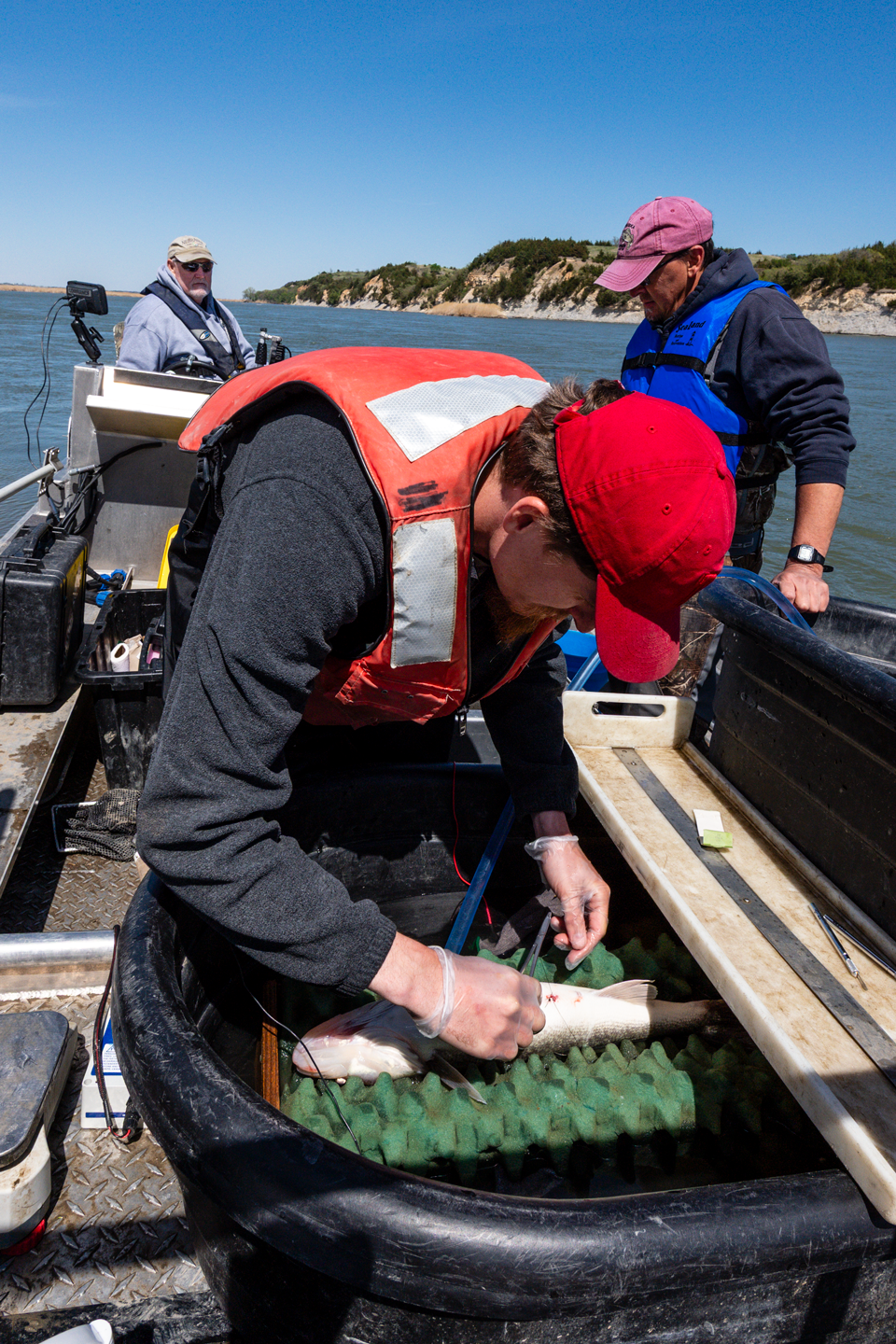
The study won’t lead to any changes in how either state manages the river or reservoir. Movement data showed that biologists are sampling in locations that accurately measure the subpopulations of walleye. It did show that it will be difficult to accurately count sauger, many of which remain in the delta.
“If we could figure out the logistics on that, it might be a good way to get some information, but boy that’s difficult,” Schuckman said, pointing to the braided nature of the river in the delta and the area it covers that makes it hard to cover with gill nets or electrofishing.
Schuckman said he was most surprised by the number of fish that moved out of the reservoir to spawn in the delta or beyond, a fact that explains the difficulty they had helping Radigan capture fish to tag there during the spring. “In most of our reservoirs in the state, you go to the dam in the spring of the year and it’s full of spawning walleye,” he said. “That is not the case in Lewis and Clark Lake.”
Radigan said area fishing guides were instrumental in the study, helping Radigan catch fish to tag with rod and reel or telling him where they could catch them with electrofishing gear.
With low releases in recent years, biologists’ catch rates have improved significantly, as has the fishing. “We’re building numbers, and fishing in 2025 is indicative of that,” said Schuckman. “Life is good. They caught a lot of limits of walleye out of Lewis and Clark Lake this spring.”
Radigan and Schuckman agree anglers need to enjoy catching and keeping those fish now. “We’re one high-water year away from losing a bunch of them again,” Schuckman said.
Fish Tagging
While the receivers were removed from the system at the end of the study and transmitters no longer work, there are still up to 180 tagged fish swimming in the reach. While some of those may have lost the metal jaw tags they received, anglers might find a transmitter while cleaning a fish. Those who do can still report it to the Game and Parks fisheries staff in the Norfolk office, SDGFP staff in Chamberlain, or by emailing Will Radigan at [email protected] to learn when and where the fish was tagged.