
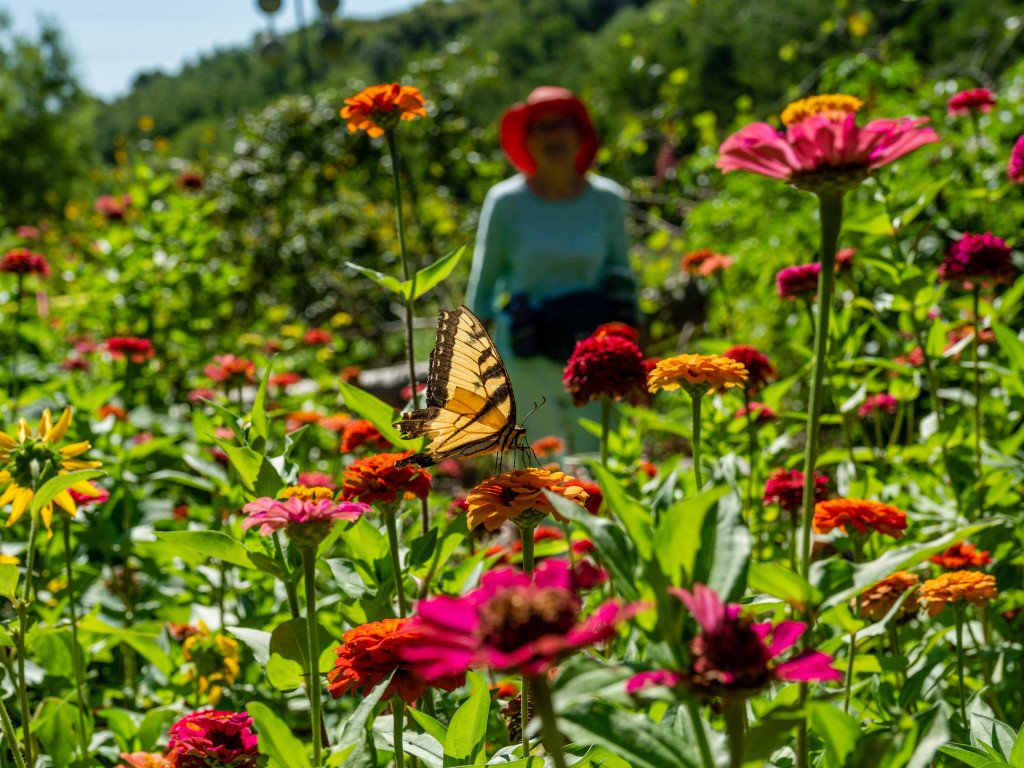
Story and photos by Renae Blum
It had been a slow year so far. But not at this moment.
Joanne Langabee calls out, “I’ve got an orange and a blue!” Her companion, Holly Hofreiter, responds almost immediately: “I’ve got a Peck’s” — short for Peck’s skipper.
One butterfly after another materializes from the prairie grasses at their feet, just seconds apart, but the women aren’t fazed. They continue calling back and forth in a kind of butterfly shorthand, identifying new species as quickly as they appear and writing them down in a notebook.
When you spend as much time counting butterflies as Joanne and Holly do, you need a shorthand. The pair, both retired science teachers, count and identify over 14,000 butterflies each year at Fontenelle Forest and Lauritzen Gardens in Omaha. Staff use their data to shape how they manage and understand these sites. And now, researchers at the Nebraska Game and Parks Commission plan to incorporate Joanne and Holly’s data into statewide conservation planning.
“Conserving species first requires understanding where they occur, what their habitat needs are, and how they are doing. This information is the result of painstaking work of many people, and the work by these researchers is a great example,” said Rachel Simpson, who manages the Nebraska Natural Heritage Program database.
A Labor of Love
The women keep to an intense schedule: From mid-April to mid-October, they visit Lauritzen Gardens once a week and Fontenelle Forest twice a week, following the same routes every time. It’s a team effort: One person looks to the right, the other to the left, calling out what species they see so the other can verify. Joanne also snaps pictures of the butterflies, which she shares with Creighton University professor Ted Burk when she could use a second opinion.
After six years of surveying, Joanne and Holly still get excited at seeing the first butterfly of the day after a slow morning, or when the sun comes out on a cloudy day, potentially attracting more butterflies. One morning, their faces lit up when they spotted a viceroy, a relatively uncommon butterfly to see along their route at Fontenelle Forest, and they paused for several minutes to enjoy the sight.
Surveying isn’t easy work. Joanne and Holly are 72 and 71 years old, respectively, and their hikes at each location are hours long; Joanne affectionally calls a part of the trek at Fontenelle Forest “the rollercoaster” for its steep inclines. The two-hour walk through Lauritzen Garden’s 100-acre campus includes wading through waist-high grasses, stepping through shrubs and climbing hills to lesser-visited places in the garden.
“It’s not just a nice little path,” Joanne commented, Holly adding that she’s a bit rusty every spring until she can get back in shape.
Another challenge about butterfly surveying is that identification can be tricky. Butterflies fly in an erratic pattern to evade birds and can easily be mistaken for falling leaves, grasshoppers or moths. Simply spotting them at all can be difficult without practice. But after spending time with Holly and Joanne, it’s apparent how quick their eyes are: They can spot a brown praying mantis camouflaged in the grass and notice butterflies the size of a fingernail.
Joanne and Holly’s butterfly knowledge was hard-won —they’re entirely self-taught. The two met in Nebraska’s master naturalist program, which offers training and volunteer opportunities to anyone interested in the natural world. The two connected easily: They are both from Bellevue and are both women interested in nature. They began surveying for butterflies after an introductory class at Lauritzen Gardens, but it was slow going at first.
“We started knowing zero,” Joanne said. “The first year it was just learning [the species]. … It was about three years to where we were pretty comfortable.”
As they gained knowledge and experience, the surveying grew in complexity.
“It’s something that just built,” Holly said. “We started out, and it was really simple. And then we would talk about it and say, ‘What if we counted them? What if we wrote down what gardens they were in?’”
Simple Rewards
What can motivate someone to spend hours every week looking for butterflies? For Holly and Joanne, part of it is pure logistics: If they didn’t go every week, they would be missing out on important data.
“Butterflies don’t have that long of a lifespan, so if you go out just once a month, you can miss a whole species,” Holly said.
But beyond that, there are many reasons why they do what they do. Part of it is the sheer adventure that every day of surveying brings.
“I think one of the things that keeps us going is seeing how it changes, what’s going to be new the next day, or that year. The unknown,” Joanne said. “You don’t really know what you’re going to discover.”
Another big pull is the camaraderie between them; the two say they’re best friends, and they enjoy exchanging ideas about what they’re observing. “We can bounce ideas off of each other and see what’s new each week,” Joanne said.
Holly also appreciates the exercise, the chance to learn, and the chance to give back. “The project gives me the opportunity to gather data to help shape the decisions made on a local level about habitat restoration,” she said. And, through presentations and butterfly tours that she and Joanne give, they’re able to communicate about habitat, species decline and climate change, she said.
Making a Difference
Each year, Joanne compiles the information into two reports summing up what they’ve observed at Fontenelle Forest and Lauritzen Gardens. She analyzes each trail, garden and butterfly that she and Holly saw, including bar charts, pictures, graphs and endless arrays of numbers. Last year, her reports each spanned over 130 pages.
The data is welcome, site managers say. “It’s extremely valuable,” said Michelle Foss, director of resource stewardship at Fontenelle Forest. “Every year I get super excited about going through the reports with Joanne and finding out what they’ve seen.”
At Fontenelle Forest, staff use Joanne and Holly’s data to help measure the success of their restoration efforts. The area, once a healthy oak woodland, is overrun with invasive plants and animals, as well as shade-tolerant trees that wouldn’t typically be found there. As trees are removed, and a more open forest structure is restored, staff are hoping to see butterflies that prefer that type of habitat, showing that restoration efforts are working. While it’s still too early to see big differences, those butterflies are starting to show up, Foss said.
At Lauritzen Gardens, Joanne and Holly’s work helps inform how the gardens are managed: what is planted, how it’s maintained, and when and if pesticides are used. It’s encouraging for the staff to see explosions of butterflies when native plants are included in the landscape, and they’ve made changes to help keep butterfly numbers high, said Jim Locklear, Lauritzen’s director of conservation.
Now in their seventh year of surveying, Joanne and Holly’s reports will be used in a new way. Nebraska Game and Parks researchers plan to include their work in a database of Nebraska’s at-risk species, as well as an update of the Nebraska Natural Legacy Project, the blueprint for conservation in the state.
Rachel Simpson, who manages the database, was excited by the women’s finds. In several cases, “we didn’t even have a record of these species in the county or a nearby county,” she said. Work like this can help conservationists better target their efforts, she said, and shows how much a couple of skilled volunteers can contribute.
Lepidopterist Neil Dankert, who has conducted butterfly counts in Nebraska for over 30 years, agrees. “It’s an awesome piece of work,” he said. And it proves something else, Dankert said. “You do not need to be a professional entomologist to contribute to our knowledge of the flora and fauna of our state.”