
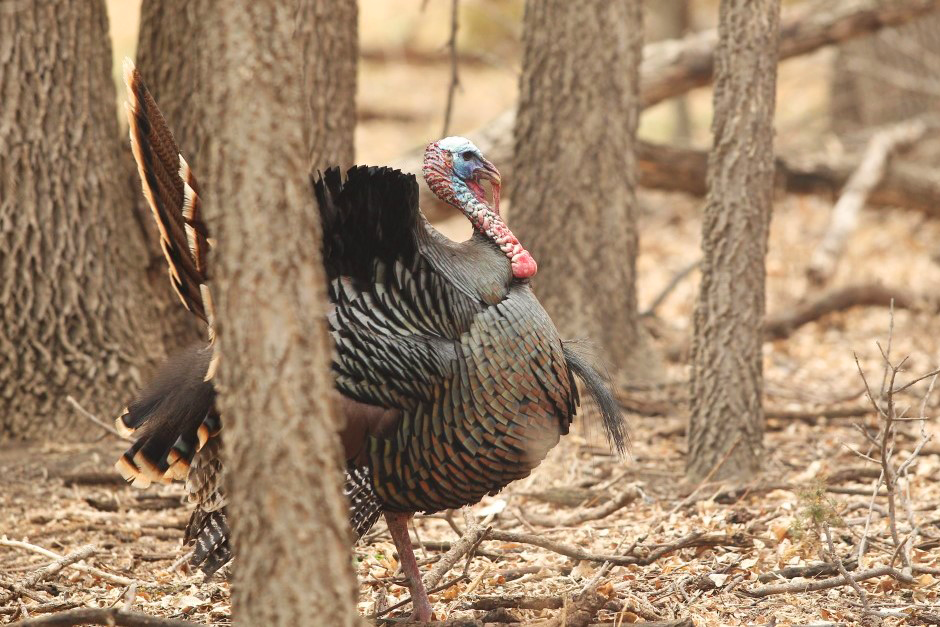
By Greg Wagner
The length of daylight is increasing. Deer have begun shedding their antlers. Some sandhill cranes are already along the Platte River in south-central Nebraska. It is calving season on ranches in the Nebraska Sandhills. These are all indicators that spring is just around the bend.
For those of us who hunt wild turkeys in the spring, our thoughts are drifting to the woods where we stake our blinds and decoys and hear those early morning gobbles. Gil-obble-obble-obble!
An old, wise turkey hunter I once knew said, “You should scout a heck of a lot more than you hunt.” This is true with turkey hunting, especially with lower bird numbers. You will not harvest a gobbler or a jake if the property you are hunting doesn’t have turkeys on it, so you need to spend time scouting before the season starts.
A trip to where wild turkeys reside or frequent can be a refreshing and welcomed activity when the weather cooperates. Yes, I know, it’s still chilly outside, but there is a reason to spend time in the woods you plan to hunt. Turkeys!
Scouting considerably in advance of your season opener is the best way to help improve your odds for a successful spring wild turkey hunt, particularly for the archery season. Nebraska’s archery/crossbow spring wild turkey hunting season opens on March 25.
Many hunters, though, will tell you that scouting doesn’t do any good for the turkeys they hunt in late winter. They’ll say, “Why bother to scout now? The birds aren’t even there yet,” or “They’re still flocked up,” or “They’re not going to tell me anything.” My response: You don’t know unless you go. For savvy wild turkey hunters, scouting is a year-round activity, and it becomes more focused in the early- to mid-March time frame when the birds begin moving from wintering areas to breeding areas.
Case in point: Wild turkeys may not be large animals but they may travel further than you think, according to an ongoing University of Nebraska-Lincoln (UN-L) study of wild turkeys in western Nebraska. Research there shows a hen outfitted with a transmitter went 13 miles from her winter range where she was captured to her spring nest site.
So, what about scouting wild turkeys this time of year? Is it really worth it? For the answer to that question, I turned to the nation’s foremost expert on wild turkeys. The expert is Dr. Michael Chamberlain, the Terrell Professor of Wildlife Ecology and Management at the University of Georgia. He thoroughly knows turkeys from both a research perspective and a hunter’s point of view. His work with wild turkeys is renowned!
Here is what Dr. Chamberlain said about winter scouting for wild turkeys:
“To me, scouting in winter allows you to get an idea of flock size, understanding that those large winter flocks are going to dissolve into smaller breeding groups as spring approaches. I view knowing where winter flocks are on the landscape as the hub in a wheel, knowing that when those flocks dissolve, they’re going to emanate out from that hub and disperse themselves across the landscape. Sometimes, like with Merriam’s, those smaller groups may end up many miles away from where they spent time in a winter flock, whereas with Easterns you tend to see them not move as far. Regardless, knowing where those winter flocks were gives you a starting point from which to work outward, if that makes sense.”
The late Dick Turpin of Lincoln, NE who was a longtime Game and Parks outdoor educator and considered to be one of Nebraska’s top turkey hunting gurus of all time, told me these things about scouting for spring wild turkey hunting: “You should scout those turkeys before you ever think of hunting them,” Turpin pointed out to me. “Get to really know the birds. I mean watch ’em close and get to know each individual one. Learn the dynamics of the flock, too … their pecking order, daily routines and roost trees.” “The key thing is to find their core area,” stressed Turpin. “That’s something that won’t change much even when things start greening up.”
Current Nebraska field conservation officer Rich Berggren of Waterloo, NE and an avid wild turkey hunter, had an interesting analogy to pass along to fellow turkey hunters. He said, “If you’re a deer hunter, you have your game cameras up and running well before the season opens and you scout prior to the season, right? So, if you’re a spring turkey hunter, why wouldn’t you do the same things? I sure do and they have improved my odds for success because I know what the birds are doing and I can pattern them.”
Dr. Andrew Little, Assistant Professor of Landscape Ecology and Habitat Management in the School of Natural Resources at the University of Nebraska-Lincoln (UN-L), said this regarding late-winter scouting for spring wild turkey hunting: “Get off the beaten path! Spend some time scouting both with trail cameras and glassing fields to learn where turkeys are spending their time now and where they probably will be spending time throughout the hunting season. It’s easy to hunt near readily accessible points but turkeys like deer and other game species learn quickly and can simply move to less accessible areas to avoid hunting pressure. If you find these places now, you’ll be less likely to encounter other hunters and potentially more likely to improve your success this spring.”
According to Little, “One thing we have seen based on our GPS data in western Nebraska is dispersal from winter to spring grounds appears to be around that last week of March to the early April timeframe. I think this is important for hunters, especially if they’re out scouting birds now or into early April. The birds they see today may not be the same birds that occur on their property during hunting season.”
“Who knows though with all these warm days that might mix things up a little bit,” added the professor.
“Adaptability is the key to success in turkey hunting, but patience is just as important. As flocks break up, be adaptable but also know when to sit tight and let the birds come to you,” emphasized Little.
Scouting Tips
Location, Location, Location
Although daily movements of resident birds may change, most often wild turkeys will utilize the same habitat annually that meets their needs — particularly roosting cover/trees, seasonal food sources and spring breeding/nesting sites. These locations should be noted on maps or map apps. As a matter of reference, research in Nebraska shows that wild turkeys prefer two types of trees for roost sites — the eastern cottonwood found statewide and the ponderosa pine in the west. I would not overlook the structure of large hackberry or American elm trees for wild turkey roosting cover either. Usually you won’t find them roosted very far from a water supply either, and if they can locate the right trees situated over running water, that is ideal scenario to them. I find that east slopes over water to greet the warmth of the morning sun are highly sought by turkeys. Mark not only where turkeys are roosting, but also where they land after flying down from their roost.
Turkeys really like open woods, too. Stands of woodlands that have somewhat open understories allow turkeys to easily see danger, be in cover and forage for mast. Open understories usually occur in woods with high canopy cover containing large, mature trees.
In agricultural areas, turkeys often depend on harvested row crop fields or livestock feed yards for waste grain or may even target freshly planted agricultural fields for food. Wild turkeys also scratch for seeds and acorns as well as eat everything from insects to earthworms to green matter. They seek out grasslands that have underwent prescribed burns for the insects, seeds and new growth they offer.
Go Low Impact
Do not “educate” or disrupt turkeys. Wildlife biologists say winter scouting should be done as stealthily as possible, so as not to spook wild turkeys or other wildlife that could alert wild turkeys. The less contact you have with a male wild turkey before you hunt him, the better the chances are that you’ll be able to lure him into range when it counts. Do I call? I typically do not. It is generally not recommended to call turkeys in the preseason, but with a few exceptions. Basic turkey calling should not have any effect on the birds other than to elicit a response — unless, of course, you’re careless and spook them! If sunrise happens and your terrain is silent. If I call, I will employ a barred owl call and blow the “who-cooks-for-you” refrain. If that doesn’t work to get a gobbling response, I’ll try a crow, hawk or pileated woodpecker call.
Interestingly, studies prove turkeys can recognize individual turkeys, so biologists believe they must also recognize different calls and associate the same type, tone, frequency and duration of calling being from the same individual. The bottom line: If a hunter calls in and spooks a gobbler, the gobbler from then on may associate the same call or type of calling with a bad experience and refuse to come close, or stop gobbling altogether.
Also, scout about the first light of the day, if possible, from high vantage points or where you can at least see and hear for long distances. Use good binoculars and spotting scopes to glass for birds in the trees. Similar information can be gathered in the evenings, especially using the barred owl call nearing sunset. In fact, you have may have the opportunity to see and hear birds flying up in their roost trees for the night. Watch and listen for turkeys creating a ruckus taking the roost, but don’t get too close! Put them to bed, so to speak, and discreetly leave.
For midday hours, careful scouting from a vehicle is an effective way to gain valuable details about individual birds, flocks, habits and routines. Plus, scouting from a motor vehicle won’t disturb the birds. They are used to seeing motor vehicles. Drive interior farm, ranch and acreage roads if the landowner doesn’t mind and the conditions allow. In addition, when we have those 50-plus degree days, take a quiet, stealthy hike wearing your camouflaged clothing and understand the lay of the land as it applies to turkeys. There’s no foliage to obscure your view, and since turkeys haven’t quite dispersed into their springtime ranges yet, you don’t have to worry as much about causing total disorder.
Sign, Sign, Everywhere a Sign
Wild turkeys almost always leave a mess wherever they are and give up their whereabouts. Fresh droppings from turkeys are a primary indicator of birds in the area. Ordinarily the scat is small and cylinder shaped, with a diameter slightly bigger than a penny. The ends of the droppings are usually somewhat blunt in form and the scat often curls in one direction. A heavy concentration of fresh droppings under trees can indicate current roosting areas. Know that droppings made by each gender of the bird aren’t always uniform and identifiable.
Tracks are crucial to examine and determine gender and numbers. Hens and gobblers leave behind three-toed tracks, but the middle toe of the gobbler is longer than his other digits. Gobblers have tracks that are approximately 4 1/2-inches long from the base of the heel to the tip of the center toe, while hen tracks are an inch shorter. You can count the sets of tracks to determine flock size. Look for other turkey signs as well.
Molted feathers (a gobbler’s body feathers are black-tipped, while hen feathers are buff-colored) and moreso, primary wing feathers near suitable trees, may uncover roosts. Also, scratch marks in leaves where the turkeys have uncovered food such as acorns, dusting areas where they’ve rolled in loose soil and created a shallow depression, and even narrow, parallel wing drag lines from strutting, can provide clues to their presence. An abundance of different signs suggests that wild turkeys are hanging out in the area. Putting the pieces of this puzzle together gets you ever-closer to cancelling your Nebraska turkey permit tag.
Take Photos, Apply Technology
You know those high-tech, digital trail cameras you used to identify white-tailed or mule deer before your specific deer hunting season opened? They work just as well for pinpointing where certain wild turkeys are during various times of the day and what their behavior is then. The key is to watch for hens. Find the hens and the toms will be around somewhere close. Jakes (juvenile male wild turkeys) quite often like to associate in small bachelor groups. You might even catch a few gobblers on the move. Set up along active game trails (turkeys tend to utilize the same travel lanes as deer), food plots, field edges, vehicle paths, and forested ridges, and be sure to log the data the trail cameras provide.
Also, don’t be afraid to add modern technology to your preseason preparation list for spring wild turkey hunting either. Whether its onX, Google Earth (Earth View), HuntWise or some other hi-tech means, you can learn a great deal about the lay of the land and terrain features in brief bit. These will help you narrow down likely areas of turkey habitat use, save time and make your actual scouting sessions more effective.
Know Your History
The old cliché, “History tends to repeat itself,” is the case when it comes to spring wild turkey hunting. Comprehending what turkeys have done in past spring seasons is critical to present and future hunting success. Learning how turkeys interact within the landscape of your hunting property is paramount. Is there an exact spot where they like to cross a creek? Do they have established roost trees? Where do they like to strut? Where have hens typically nested in the past? Calling in a tom is much easier when you’re sitting or positioned where he wants to go!
Miscellaneous Tips
When scouting publicly-accessible land for spring wild turkey hunting, look for the larger tracts, scout and plan a hunt on them during the week, and hunt as far away from roads and parking lots as you can get.
On private land, take time to politely quiz the landowner for turkey information. Chances are the farmer, acreage owner, or rancher doesn’t hunt turkeys, but knows what the birds are doing, and where the birds are in the mornings, afternoons and evenings and with assorted weather conditions. And keep a log of this information.
It is a memorable moment when a big tom turkey answers your call and comes to within shooting range. This is when your preseason scouting work pays off. Remember, the more information you have about wild turkeys, the more your chances for success increase!
Get more information about spring wild turkey hunting in Nebraska by visiting OutdoorNebraska.gov.
I wish you good scouting, good hunting and great experiences! – GW